

The offshore software development industry has existed for decades. The patterns of what works and what fails are well-documented. The same industry applied to AI development is newer — but the failure patterns are already recognisable, and they have some AI-specific characteristics that businesses need to understand before choosing an offshore AI development company.
This guide is written from the inside. Automely is an offshore AI development company based in Karachi, Pakistan, serving clients across the US, UK, and EU. We know what creates the 60–70% cost savings that make offshore AI compelling. We also know exactly what causes offshore AI projects to fail — because we have been called in to rescue several of them from other vendors.
Offshore AI development works when the offshore company has verifiable production AI experience, the contract properly protects your IP, and the communication structure is defined in writing. It fails when any of those three conditions are missing — and most offshore AI failures trace back to exactly one of them.
The Quality Gap Question — Is It Still Real in 2026?
The conventional concern about offshore AI development is quality. The assumption is that offshore equals lower quality — that you get what you pay for, and 60–70% cheaper means proportionally worse work.
For general software development, this assumption had some truth to it a decade ago. For AI-specific development in 2026, it does not hold at the top of the offshore market — for a specific and important reason.
The tools that power modern AI development are global and open. LangChain, LangGraph, LlamaIndex, OpenAI API, Anthropic API, Pinecone, Weaviate, Hugging Face — these are available identically to a developer in Karachi, Warsaw, or San Francisco. The training data for AI-specific skills is the same everywhere. The production failure modes in RAG systems, agent orchestration, and LLM pipelines are the same everywhere. A developer who has shipped a RAG system handling 50,000 queries per day in Pakistan has learned exactly the same lessons as a developer who shipped the same system in London — at a fraction of the cost to train and retain.
The quality gap that does exist in offshore AI development is between experienced and inexperienced teams — not between geographies. A verified offshore AI agent development team with production track record outperforms a local agency with demo-only experience on every measure that matters: reliability, production stability, cost efficiency, and timeline accuracy.
The key word is “verified.” The offshore market also contains a significant number of AI development companies with no production experience that present convincingly. The vetting framework in this guide exists specifically to separate the two.
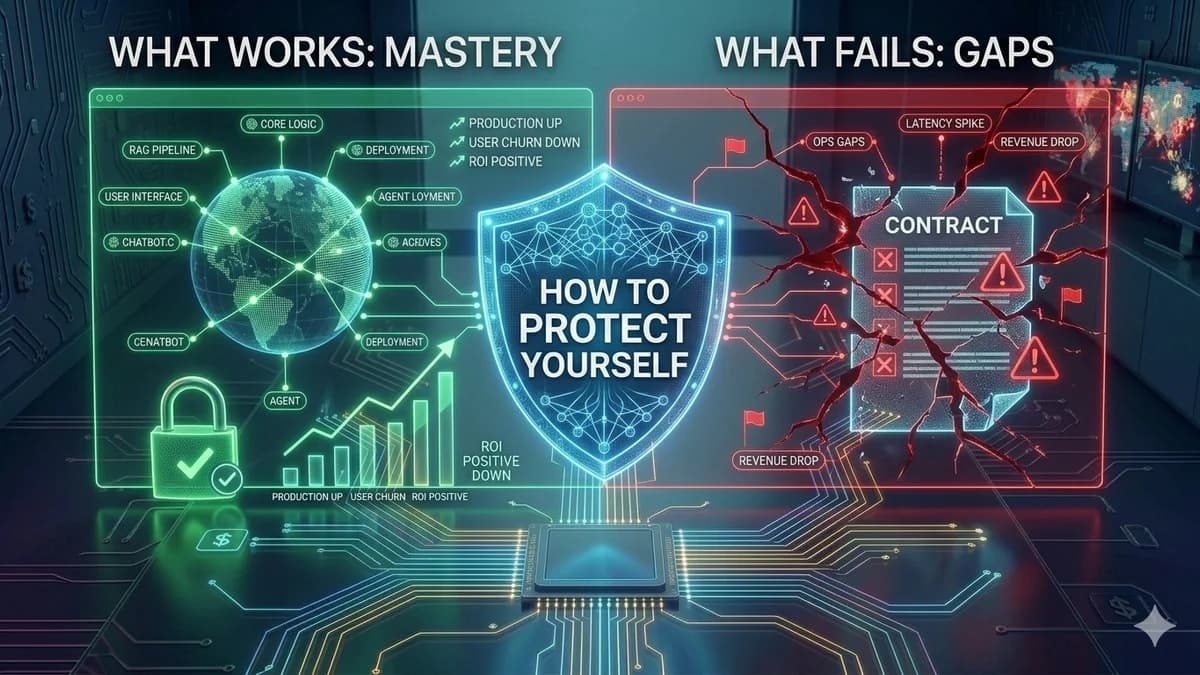
What Actually Works and What Consistently Fails
✓ What Works Well Offshore
- Senior AI engineering talent at 60–70% below US rates
- Full-stack AI product builds (frontend, backend, LLM integration)
- RAG systems and knowledge base architecture
- Multi-tool AI agent development with CRM/business integrations
- 24-hour development cycles with US-side review + offshore build
- Generative AI feature development for existing products
- AI automation and workflow systems
- Production monitoring and ongoing maintenance retainers
✗ What Fails in Offshore AI Projects
- Hiring on price without verifying production AI experience
- No discovery phase — scope defined too loosely before build
- IP ownership not explicitly assigned in the contract
- Systems built in agency accounts rather than client infrastructure
- Communication structure informally agreed rather than contractually defined
- Acceptance criteria vague (“when it works”) rather than measurable
- No post-launch support plan — system degrades without maintenance
- Data quality assumed clean without assessment — then discovered not to be
The pattern in this table is important: everything in the “fails” column is preventable before the contract is signed. The failures are not caused by offshore geography — they are caused by process gaps that would cause failure with a local vendor too. Offshore adds a communication dimension that makes those process gaps slightly more expensive. It does not create new fundamental failure modes.
The Real Cost Savings — And What They Actually Fund
The 60–70% cost saving versus US or Western European equivalents is real. Here is what the market actually looks like in 2026, with the caveat that these are rates for verified production-capable AI developers — not junior or tutorial-level candidates.
| Region / Model | Hourly Rate | Monthly Retainer (Senior) | Annual (Full-Time Equiv.) | Saving vs US |
|---|---|---|---|---|
| 🇺🇸 US-based Agency | $150–$300/hr | $18,000–$25,000/mo | $130,000–$220,000/yr | — |
| 🇪🇺 Western Europe | $120–$200/hr | $14,000–$20,000/mo | $110,000–$180,000/yr | 15–25% |
| 🇵🇱🇺🇦 Eastern Europe | $80–$140/hr | $8,000–$13,000/mo | $70,000–$110,000/yr | 40–55% |
| 🇵🇰🇮🇳 South Asia (Specialist Agency) | $50–$100/hr | $4,000–$8,000/mo | $35,000–$70,000/yr | 60–75% |
| 🇨🇴🇲🇽 Latin America | $60–$110/hr | $5,000–$10,000/mo | $45,000–$85,000/yr | 50–65% |
On a 12-month senior AI developer engagement, a South Asian specialist agency versus a US agency represents a total saving of $130,000–$180,000. Over a two-year product build, that difference funds an additional 6–10 developer-months of work — effectively getting a 3-person team for the price of a 2-person US team.
The caveat that matters: these rates are for experienced, production-capable AI developers at specialist agencies. They are not the rates for junior developers at generic offshore software factories that have added “AI” to their website. Verifying that the team you are engaging belongs to the first category — not the second — is what this entire guide is about.
Want to verify Automely's production track record before committing?
Book a free 45-minute call. We will show you specific shipped systems, connect you with direct client references, and give you a detailed scope — before you commit anything.
The 6 Offshore AI Project Failure Patterns (And How to Prevent Each)
Hired on Price, Not on Production Verification
The most common cause of offshore AI project failure: selecting a vendor based primarily on rate rather than verified production AI experience. The offshore market contains a large number of companies that have written competent AI tutorial code and present as production AI experts. At $20–$30/hour, they look like outstanding value. When their systems fail under real user load, the cost of the rebuild exceeds what would have been saved.
IP Ownership Left Ambiguous in the Contract
Without an explicit IP assignment clause, work product created by an offshore contractor may remain with the contractor under their local law — regardless of what was verbally agreed. In AI development, the commercially valuable work product includes not just code but model weights, fine-tuned models, vector database contents, prompt architectures, and training data. Each needs to be explicitly named in the assignment clause.
Systems Built in Agency Infrastructure, Not Client Accounts
An offshore AI development company that builds your system in their cloud accounts, their vector database instances, and their API subscriptions retains operational leverage over your product after delivery. Migrating a production AI system to new infrastructure is expensive, risky, and time-consuming — and the threat of that cost is leverage the agency may or may not be consciously aware they hold.
Communication Structure Informally Agreed Rather Than Contractual
In any offshore engagement, communication discipline degrades under delivery pressure unless it is contractually defined. An informal agreement for “weekly updates” becomes increasingly irregular as the team faces production challenges. Decisions that need client input get delayed. Problems that could be addressed early compound into late-stage failures.
No Discovery Phase — Scope Defined Too Loosely
Offshore AI projects that skip a formal discovery phase before development begins almost always encounter mid-project architecture changes, data quality surprises, or integration challenges that were not accounted for in the timeline or budget. The distance of an offshore arrangement makes these mid-project pivots more expensive than they would be locally — because course corrections require more communication overhead to implement correctly.
No Post-Launch Plan — System Degrades Without Support
AI systems degrade in ways that standard software does not. LLM API providers change pricing, deprecate models, and update their interfaces. RAG knowledge bases become stale as business information changes. Production usage reveals edge cases that test inputs never uncovered. An offshore AI project with no post-launch support plan delivers a depreciating asset that the client cannot maintain independently.
The IP Protection Framework for Offshore AI Development
IP protection in offshore AI development requires both legal and technical measures. Legal without technical is insufficient — a contract that assigns IP to the client means nothing if the code lives in the agency's private repository and cannot be transferred without their cooperation.
Step 1 — NDA Before Anything Is Shared
Sign a comprehensive NDA before any proprietary information — your business requirements, your data samples, your existing system architecture — is shared with the vendor. The NDA should cover pre-engagement conversations and all project information for a minimum of five years. Do not rely on a vendor's standard template NDA; have a lawyer review or provide your own.
Step 2 — Explicit IP Assignment in the Development Contract
The IP assignment clause must be explicit and comprehensive: all code, model weights, fine-tuned models, training datasets, prompt architectures, system documentation, evaluation frameworks, and derivative works created during the engagement are assigned in full to the client upon payment. The vendor retains no rights. No carve-outs for “general skills and knowledge” broad enough to encompass your actual work product.
Step 3 — Client Ownership of All Platform Accounts
Before development begins: create your GitHub organisation, your cloud infrastructure account (AWS/GCP/Azure), your vector database account (Pinecone/Weaviate), your LLM API accounts (OpenAI/Anthropic), and any other platform accounts the project requires — all in the client's name. The offshore team receives contributor access as named users. They never hold account ownership.
Step 4 — Code Committed to Client Repositories From Day One
All code must be committed to client-owned repositories from the first day of development. No code should exist exclusively in the agency's own systems at any point. Regular commits — at least daily during active development — ensure that if the engagement ends for any reason, the client has immediate access to all work product to date.
Step 5 — Data Handling and Deletion Obligations
Any AI project involving customer data requires a data handling agreement specifying what data the agency can access during development, how it is stored, what security controls are in place, and a documented data deletion process when the engagement ends. This is both a legal protection and a practical risk management measure.
The Offshore AI Development Company Vetting Checklist
Offshore AI Development Company Vetting Checklist
Production Track Record
IP and Account Ownership
Process and Communication
Post-Launch
Red Flags Specific to Offshore AI Development Companies
Their entire portfolio is demos, case study PDFs, and prototype screenshots — no live production systems. This is the primary tell in the offshore market. Building demo AI is orders of magnitude easier than building production AI. An offshore AI development company without live production systems has not navigated the challenges that determine real-world project success.
They resist building in your accounts from day one. Any resistance to this structural requirement — however framed — indicates that the standard model retains leverage for the agency after delivery. “That's not how we normally work” is the answer that confirms you should walk away.
Their proposal lists every AI buzzword without technical specifics. “Leveraging LLMs to power your AI transformation using cutting-edge RAG and advanced agentic workflows” says nothing. A real technical proposal names the specific model, the specific framework, the specific vector database, and the specific architecture decisions — with rationale. Buzzword density is inversely correlated with technical depth.
They quote before completing discovery. Any offshore AI development company that delivers a firm quote within 24 hours of the first conversation is bidding on assumptions. Either the assumptions are wildly optimistic (you will pay for it in scope disputes) or the quote is heavily padded with a 30–50% risk premium for the unknown. A proper quote follows a proper discovery phase.
They cannot name the specific developer who will work on your project. A senior developer's reputation was used in the sales process but a junior team will deliver — this is a common pattern in offshore agencies. Ask to meet specifically with the AI developers who will build your system, not the sales or account team.
The rate is significantly below market even for the region. $15/hour for a “senior AI developer” in South Asia in 2026 is not a bargain — it is a signal that the person has tutorial-level experience being sold as production expertise. Market rates for genuinely experienced AI developers in South Asia are $50–$100/hour or $4,000–$8,000/month as a retainer. Rates significantly below this floor in exchange for promises of equivalent quality do not deliver equivalent quality.
The Automely Offshore Model — Why We Are Different
Automely is a specialist offshore AI development company based in Karachi, Pakistan, with a Delaware entity that legally serves US, UK, and EU clients. We are not a general software agency that added AI to its service list. Every service we offer — AI agent development, generative AI development, AI chatbot development, AI integration services, SaaS development, and MVP development — is delivered by a team that has shipped production AI systems with real users.
Our production track record includes Lamblight — a Scripture-based AI journaling app with 20,000+ active users and $312K ARR — and Cerebra Caribbean — a multi-channel AI communication platform that has automated 10,000+ customer conversations for Caribbean businesses. Both clients are available as direct references for any prospective client to contact before making any decision.
Every engagement at Automely includes full IP assignment as a contractual standard — all code, models, architectures, and documentation belong to the client upon payment. Every project is built in client-owned accounts from day one. Every contract includes a defined communication cadence, milestone-based payments, and a post-launch support plan. These are not selling points — they are the minimum standard we hold ourselves to, and they are written into every contract we sign.
Our 4.9★ Clutch rating across 50+ clients reflects 120+ delivered projects, not a marketing strategy. Read our case studies, review our client testimonials, meet the Automely team, and then apply the vetting checklist in this guide to us exactly as you would to any other offshore AI development company. That is the process we welcome.
Ready to apply the vetting checklist to Automely directly?
Book a free 45-minute discovery call. Ask us every question on the checklist. We will give you specific, verifiable answers — production references, technical walkthroughs, and a detailed project scope — before you commit anything.