


The AI automation agency market has exploded. There are now thousands of agencies claiming they can transform your business with AI — and most of them are selling something that sounds impressive in a deck but fails the moment it hits production.
The problem is not that AI automation does not work. It does — when it is scoped correctly, built by engineers who understand production systems, and handed over with proper documentation. The problem is that most buyers cannot tell the difference between an agency that has shipped real production automation and one that has shipped demos and POCs.
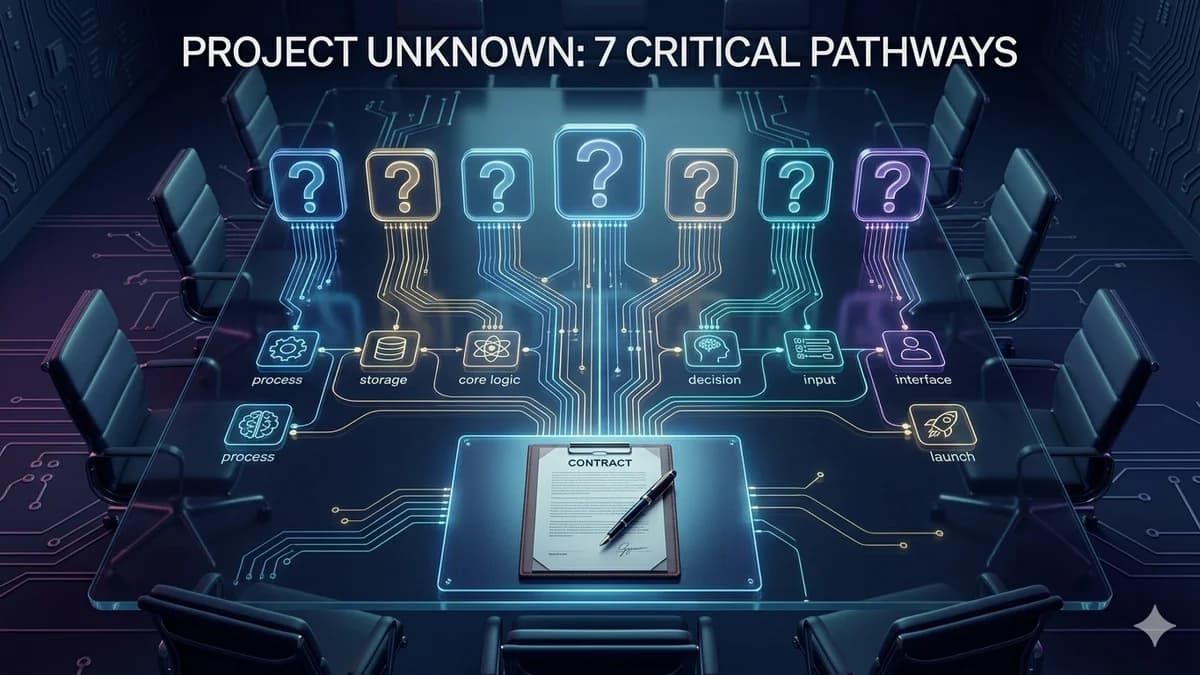
This guide gives you 7 specific questions to ask before you hire. Not vague best-practice advice — specific questions that expose whether an agency has real production experience or is still figuring it out on your budget.
Business leaders, operations managers, and CTOs evaluating AI automation agencies in 2026. You may not have deep AI technical knowledge — this guide is designed to give you the questions that surface the real signal without requiring you to be an ML engineer.
Why Most AI Automation Agencies Underdeliver
Before the questions, it helps to understand why this market produces so many disappointments. The AI hype cycle created an explosion of agencies in 2023–2025 — many of them built by people who had learned to use AI tools but had never shipped production software at scale.
There are three patterns that account for most failed AI automation engagements:
- Scoped to impress, not to deliver. The demo works. The system is architected to look good in a presentation. Then production edge cases hit — unstructured inputs, API failures, unusual data — and the system breaks because it was never designed to handle real-world conditions.
- No ownership handover. The agency builds the system but the client has no idea how it works, cannot maintain it, and is permanently dependent on the agency for every change. This is not a partnership — it is a subscription model in disguise.
- Metrics defined after delivery. Success criteria were never agreed upfront, so there is no objective way to evaluate whether the automation delivered value. The agency declares success. The client is not sure what they paid for.
The seven questions below are designed to surface all three of these failure modes before you sign anything.
Show me a case study with specific outcomes
Not a logo wall. Not a testimonial. A specific system, the problem it solved, and the measurable result.
What do you need to understand before scoping this?
Good agencies ask questions. Bad agencies jump straight to a proposal before they understand your business.
What ROI should I realistically expect, and by when?
Vague promises of “10x efficiency” are a red flag. You want specifics tied to your actual process.
Who owns the code and system after delivery?
You should own everything — code, prompts, configs, data. Anything less is a dependency trap.
What happens when the system makes a mistake?
Every production AI system makes mistakes. How they are caught and handled is the real test of production readiness.
Have you worked in our industry before?
Industry-specific compliance, data structure, and process nuance matter more than general AI capability.
What does post-launch look like?
Launch is not the end. Models drift, APIs change, edge cases surface. You need a defined support structure.
Question 1: Show Me a Case Study With Specific Outcomes
This is the single most important filter. Any agency can produce a logo wall. What you need is a verifiable case study — a specific client, a specific problem, a specific system they built, and a specific measurable outcome.
Not “we helped a retail company improve efficiency.” That means nothing. What you want is: “we built an invoice processing automation for a logistics company that reduced manual processing time from 4 hours per day to 20 minutes, with a 99.2% accuracy rate on structured invoice fields.”
A named client (or at least a verifiable industry and company size), a specific workflow automated, a before/after metric with actual numbers, and an honest statement about what the system still cannot handle reliably.
They show you a demo, a prototype, or describe a “solution we've built for similar businesses” — but cannot point to a live production system with measurable outcomes. POC experience is not production experience.
If they have real production case studies, they will share them readily. If they deflect with NDAs, ask whether they can share the category of business, the workflow automated, and the measured outcome — even anonymised. A truly experienced agency will be able to do this.
Question 2: What Do You Need to Understand Before Scoping This?
This question reveals whether an agency is thinking about your specific business or has a pre-packaged solution they are trying to apply to every client.
A good agency, before producing any proposal or estimate, should ask you a significant number of questions: about your current process, your data quality, your existing tech stack, your compliance requirements, your team's technical capacity, your definition of success, and your timeline constraints. They cannot scope accurately without this information.
They immediately ask you about the specific process you want to automate, how your data is structured, what systems it needs to connect to, and what you consider a successful outcome. They have a discovery process, not a pitch deck.
They send you a proposal within 24 hours of the first call without asking meaningful questions about your business. A fast proposal is a template, not a scope.
The discovery process is where an experienced agency differentiates itself. They will often identify constraints, data quality issues, or integration complexity that you had not considered — and that changes the scope and cost significantly. If an agency skips discovery, they are guessing. And you will pay for the guess.
Want to see what a proper discovery process looks like?
Book a free 45-minute scoping call with Automely. We ask the right questions, scope your project properly, and give you a realistic estimate before you commit to anything.
Question 3: What ROI Should I Realistically Expect, and by When?
Every agency will tell you AI automation delivers ROI. The question is whether they can tell you specifically what ROI your project should deliver, on what timeline, with what confidence level.
Vague promises like “10x your team's efficiency” or “cut costs by 80%” without any basis in your specific process are a red flag. Real ROI estimation requires understanding your current process cost, the volume of work being automated, the error rate improvement, and the ongoing cost of the AI system.
They ask you for your current process metrics — time per task, volume per day, error rate, cost per error — and use that to calculate a projected outcome. They also give you a realistic timeline to realise the ROI, accounting for deployment, testing, and adoption time.
They quote ROI percentages without any basis in your specific numbers, or refuse to commit to any measurable outcome at all. Both extremes are a problem.
The right answer to this question is nuanced. A good agency will say something like: “Based on your current volume of X tasks per day at Y minutes each, we estimate the automation can reduce that to Z minutes, saving approximately W hours per week. At your fully-loaded cost of $A per hour, that is $B per month in direct labour savings, against a monthly system cost of $C. You should expect breakeven in approximately D months.” That specificity is what good looks like.
Question 4: Who Owns the Code, Prompts, and System After Delivery?
Ownership is one of the most commonly overlooked aspects of an AI automation engagement — and one of the most consequential. There are three distinct ownership scenarios, and you need to know which one applies before you sign.
| Ownership Model | What You Get | Risk |
|---|---|---|
| Full IP Transfer | All custom code, prompts, configs, and docs transferred to you on delivery | Low — you control everything |
| Managed Service | Agency runs the system on their infrastructure; you access via API or dashboard | High — you are dependent on agency for all changes, pricing, and uptime |
| Hybrid / Licence | Custom components owned by you; platform layer licenced from agency | Medium — understand exactly what is licenced vs owned before signing |
The contract explicitly states that all custom code, prompt templates, workflow configurations, API credentials (or migration path), and documentation are transferred to the client on final payment. No ambiguity, no ongoing licence dependency for custom-built components.
The agency is vague about ownership, says the system “runs on our platform,” or cannot show you a clause in the contract that explicitly transfers ownership of all custom work to you.
Question 5: What Happens When the System Makes a Mistake?
Every production AI system makes mistakes. This is not a failure of AI — it is a fundamental property of probabilistic systems. The question is not whether your automation will ever produce an incorrect output. It will. The question is: how is that caught, logged, and corrected?
An agency with real production experience will have a clear answer to this question. They will describe their monitoring architecture, their fallback logic, their human-in-the-loop checkpoints for high-stakes decisions, and their error logging and alerting approach.
They describe: (1) confidence thresholds that trigger human review for uncertain outputs; (2) logging and monitoring that surfaces error patterns over time; (3) a defined escalation path for errors; (4) a process for using production errors to improve the system. Bonus points if they distinguish between recoverable errors and critical failures.
“The system is very accurate, it should not make many mistakes.” This answer reveals that the agency has not thought seriously about production failure modes. Every production engineer knows that “accurate in testing” and “reliable in production” are different things.
This question is particularly important for automations that touch financial data, customer communications, or compliance-relevant decisions. The cost of an unmonitored error in these domains is often larger than the cost of building the monitoring system correctly from the start.
Question 6: Have You Worked in Our Industry Before?
General AI engineering capability matters — but industry experience often matters more for automation projects. The specific compliance requirements, data structures, integration landscape, and process nuances of your industry can change the architecture of a system significantly.
A healthcare automation has very different data governance requirements than a retail one. A financial services workflow has different compliance constraints than a marketing one. An agency that has navigated these constraints before will save you weeks of discovery and expensive architectural mistakes.
They name specific projects in your industry, describe the compliance or data constraints they had to design around, and can reference the integration ecosystem (specific ERPs, CRMs, data formats) common in your sector. They know what the hard parts are before you tell them.
They say they can “adapt quickly to any industry” without specific evidence. This is technically true of any capable engineering team — but it means you are funding their learning curve, not benefiting from accumulated experience.
If they do not have direct experience in your industry, that is not automatically disqualifying — but it should change your approach. Require a more detailed discovery process, insist on a phased engagement, and build in explicit checkpoints where you validate industry-specific assumptions before the full build begins.
Question 7: What Does Post-Launch Support Look Like?
The work does not end at launch — and most agencies do not tell you this clearly enough. AI systems require ongoing maintenance: models get updated or deprecated, APIs change, edge cases surface in production that were not caught in testing, and business requirements evolve.
Before you sign, understand exactly what happens after the system goes live. Who is responsible for monitoring? What is the response SLA if the system breaks? How are model updates handled? Is there a defined process for requesting changes, and at what cost?
A defined support tier (e.g., 30 days of included support post-launch, then a monthly retainer option), a named contact for production issues, a response SLA for critical failures, and a clear process for requesting enhancements or handling model deprecations. Everything documented in writing before the project starts.
Post-launch support is vague, requires a separate contract to define, or is entirely absent from the initial proposal. “We will figure it out when we get there” is not a support plan.
Looking for an agency with defined post-launch support?
Every Automely project includes a structured post-launch period, a named point of contact, and clear escalation paths — all defined before the project starts.
Full Red Flags Checklist: Walk Away If You Hear These
In addition to the answers the seven questions above surface, here are the specific statements and behaviours that should make you stop the conversation and evaluate more carefully.
Demos, POCs, and “we've built similar things” do not count. Production experience is different from prototype experience.
Any agency quoting “4 weeks” before they have seen your data, systems, and requirements is guessing. You will pay for the guess.
If they cannot explain how the system will work — without jargon — to a non-technical stakeholder, they either do not know or they are hiding something.
Milestone-based payment structures protect both parties. Full upfront payment removes the agency's incentive to deliver on time and to spec.
If they cannot describe what happens when the system produces an incorrect output, they have not built for production. Full stop.
If there is no agreed definition of success before the project starts, any outcome can be declared a win. Agree on metrics in writing before the build begins.
If the contract does not explicitly state that all custom code, prompts, and configurations transfer to you on delivery, assume they do not.
Why Choose Automely for AI Automation
We are Automely — an AI development agency focused on production systems for businesses across the US, UK, and EU. We have delivered 120+ projects across healthcare, eCommerce, financial services, real estate, and more.
Against the seven questions above, here is what we offer:
- Verifiable case studies. Read them on our case studies page — specific clients, specific outcomes, real numbers.
- Structured discovery. Every project starts with a scoping session before we produce a single line of scope or a number.
- ROI tied to your numbers. We build a business case for your specific process before you commit to the build.
- Full IP transfer. All custom code, prompts, and documentation transfer to you on delivery. No dependencies.
- Production monitoring built in. Every system we build includes monitoring, alerting, and defined error handling from day one.
- Defined post-launch support. Support terms are written into every contract before the project starts.
Every engagement starts with a free 45-minute scoping call. No commitment, no sales pitch — just a structured conversation about your process, what automation can realistically deliver, and what it will cost. If it does not make sense for your business, we will tell you that too.
Explore our AI agent development, AI consulting, and AI integration services — or jump straight to booking your free scoping call.