

The 3 Failures of Manual Lead Qualification — and Why 79% of Leads Never Convert
Only 25–30% of inbound leads meet basic qualification criteria. This means the majority of leads your marketing spend generates are either too early, wrong fit, or insufficiently engaged to be worth a sales conversation — at least right now. Manual qualification processes make this worse, not better, because they introduce three specific failure modes that compound the underlying problem instead of managing it systematically.
Coverage failure — human SDRs reach 30–50% of leads per day
An SDR working a full queue can realistically contact 30–50% of inbound leads in a given day. The other 50–70% wait. A lead that submitted a form at 6pm on a Friday in the US may not receive a response until Monday morning — by which point the prospect has moved on, evaluated a competitor, or simply lost the urgency that drove the initial form submission. Harvard Business Review research shows companies that respond to leads within one hour are 7× more likely to have meaningful conversations with decision-makers than those that wait longer. Manual processes structurally cannot sustain sub-hour response times at scale.
Consistency failure — qualification varies by who made the call
Manual qualification produces inconsistent data. One SDR skips the budget question because the conversation went well. Another routes a prospect to sales because the company name sounded right, even though the contact was a junior analyst with no purchasing authority. A third changes the qualification criteria based on quota pressure. The result: a pipeline that mixes genuinely qualified prospects with low-probability entries — degrading conversion rates, forecast accuracy, and rep morale simultaneously.
Speed failure — research takes 20 minutes per prospect, per rep
Before a rep can have an informed first conversation, they need to know who the prospect is, what their company does, what the buying trigger might be, and what context is relevant to the outreach. Manual research — LinkedIn, company website, Crunchbase, recent news — takes 15–20 minutes per prospect. For a team running 20 outreach conversations per day, that is 5–7 hours of research time that produces no pipeline by itself. AI reduces lead research time from 20 minutes to under 20 seconds — the same research, done automatically, before the rep opens the contact record.
The AI Lead Generation System Architecture — 5 Components
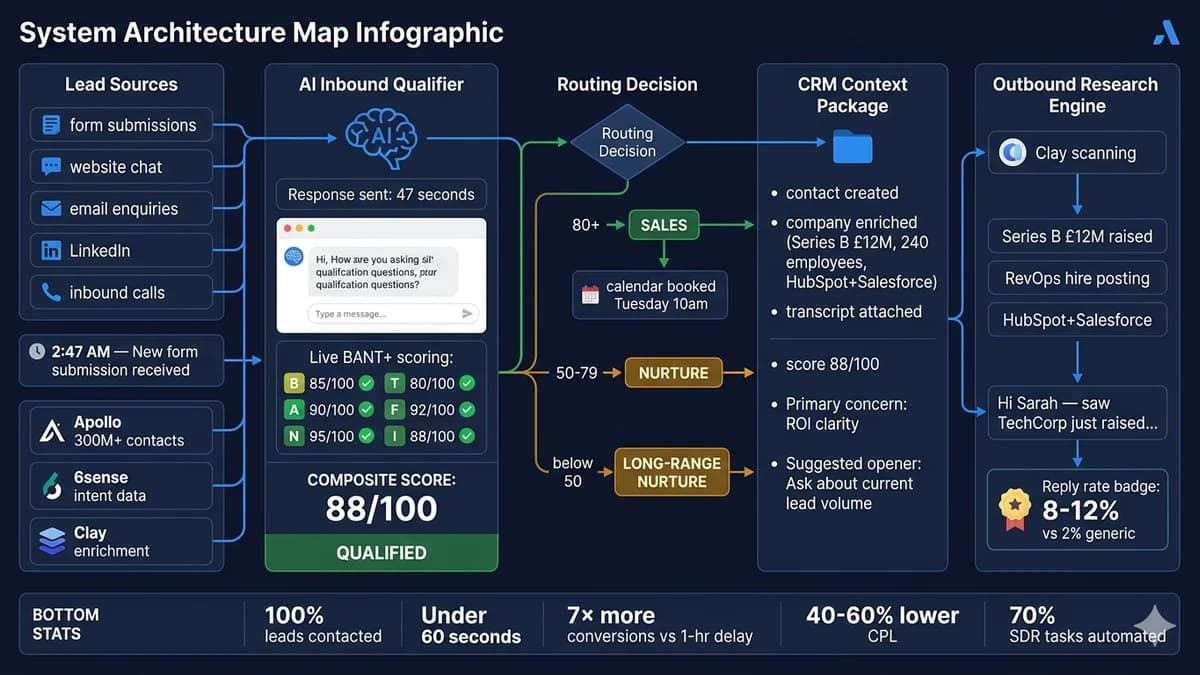
An AI lead generation system that operates autonomously 24/7 is not a single tool — it is five integrated components working in sequence. Understanding each component independently and how they connect is what allows you to build or commission a system that improves rather than degrades lead quality at scale.
What it does
Defines the exact firmographic, technographic, and behavioural characteristics of your ideal customer — and encodes them as a scoring model that every lead is evaluated against automatically. This is the filter that determines whether AI outreach reaches the right people or floods your pipeline with noise.
- Analyses your last 500 closed deals to identify the ICP pattern from actual data
- Encodes ICP as weighted scoring criteria: company size, industry, tech stack, geography, growth stage
- Defines minimum ICP threshold for outreach (e.g. score 60+ out of 100)
- Separates ICP fit from intent — a company can be a perfect ICP fit but have no active buying need
Why this comes first
Every other component in the system is only as good as the ICP definition that drives it. AI outreach to an unscored list produces 1–2% reply rates and floods sales reps with conversations that go nowhere. AI outreach to a precisely scored, ICP-matched list with active intent signals produces 8–12% reply rates and conversations that convert.
- Do not start outreach until ICP scoring is defined and validated
- Review ICP model every quarter against closed deal data
- Maintain a separate model for expansion (existing customers in new segments) vs new logo acquisition
What it does
Continuously identifies prospects matching your ICP by scanning multiple data sources, then automatically enriches each contact record with the information your reps need to have an informed first conversation — without a single minute of manual research.
- Scans Apollo.io (300M+ contacts) for prospects matching ICP firmographic criteria
- Monitors 6sense and Bombora for in-market intent signals — companies actively researching your category
- Uses Clay to enrich from LinkedIn, company website, news, job postings, and funding databases
- Detects buying triggers: funding rounds, leadership changes, new job postings in relevant roles, product launches, competitor mentions
- Reduces lead research from 20 minutes to under 20 seconds per prospect
What it enables
AI-generated personalised first-contact messages that reference specific company triggers — not just the company name. Research shows personalised emails drive 6× more transactions than generic outreach, and companies that invest in personalised outbound earn 40% more revenue than peers relying on generic cadences.
- Clay + Claude/GPT API generates hyper-personalised first lines from enrichment data
- "Hi Sarah — saw TechCorp just raised Series B and you're hiring a RevOps lead — that usually means…"
- Apollo sequences or Instantly.ai runs the delivery with deliverability management
- Reply rates move from 1–2% (generic) to 8–12% (research-driven)
What it does
Intercepts every inbound lead — form submissions, chatbot interactions, email enquiries, demo requests — and conducts a structured BANT+ qualification conversation before any human is involved. Operates 24/7 with zero queue and consistent methodology.
- Responds within 60 seconds of any form submission at any time of day
- References the specific content downloaded or page visited for contextual personalisation
- Conducts natural-language BANT+ qualification — feels conversational, follows consistent scoring logic
- Qualifies 100% of inbound leads vs 30–50% human SDR capacity
- Handles multiple languages and time zones simultaneously
The qualification conversation
Effective AI qualification conversations feel human but apply machine consistency. The AI references context from the lead's behaviour — the specific page they visited, the content they downloaded, the company they're from — to open a natural conversation that flows into structured qualification questions without feeling like an interrogation.
- Opens with context: "I saw you downloaded our AI implementation guide — what's driving that interest?"
- Moves through BANT+ naturally: budget, authority, need, timeline, fit, intent
- Assigns numerical score based on weighted responses
- Routes automatically based on score threshold
What it does
Automatically creates or updates CRM records for every qualified lead with full enrichment, qualification score, conversation transcript, and routing decision — before any human touches the record. Reps open a contact record and find everything they need for an informed first conversation already populated.
- Creates contact and company records automatically from lead data
- Enriches company record: size, industry, tech stack, funding history, recent news
- Attaches qualification conversation transcript with key answers highlighted
- Populates qualification score and scoring rationale
- Creates follow-up task or meeting for the assigned rep
The rep context package
When a qualified lead is routed to a rep, the CRM record should function as a complete briefing document. The rep should be able to read it in 90 seconds and walk into the first conversation fully prepared.
- BANT+ score and dimension breakdown
- Prospect's stated primary concern from qualification conversation
- Company buying trigger that prompted outreach or inbound
- Suggested opening question based on qualification context
- Competitor mentions detected during qualification
What it does
Leads that do not qualify today — wrong timing, early-stage research, insufficient budget — are not lost. They are routed to targeted nurture sequences that maintain engagement until their situation changes. AI monitors behavioural signals for buying intent re-activation and escalates automatically when threshold-crossing behaviour is detected.
- Routes by qualification gap: "early budget" → different sequence than "wrong timeline"
- Sequences are content-driven, not sales-driven — educational, relevant, non-pushy
- Monitors re-engagement signals: pricing page revisit, competitor comparison activity, new job posting
- Automatically escalates to sales-ready queue when intent signals cross threshold
The conversion impact
Companies using AI nurture systems report 23% shorter sales cycles on average, as leads arrive at sales conversations better informed and more committed. The nurture layer is the component that converts the 70–75% of leads who were not ready today into pipeline for next quarter.
- Sequences run automatically — no manual follow-up required
- Content is personalised by the qualification gap: budget concern vs timing concern vs need concern
- Re-qualification triggered automatically when engagement signals cross threshold
- No lead lost from "not ready now" — only from "not right fit ever"
Designing Your BANT+ Scoring Model — The Qualification Backbone
The BANT framework — Budget, Authority, Need, Timeline — is the traditional lead qualification standard. BANT+ extends it with two dimensions specifically suited to AI qualification: ICP Fit (firmographic and technographic match against your ideal customer definition) and Intent (behavioural signals indicating active buying interest). Together, these six dimensions produce a composite qualification score that drives routing decisions consistently and automatically.
Score 80–100 → Route to sales immediately. The rep receives a calendar booking prompt and the full context package. Offer a specific meeting time in the qualification handoff — “Would Tuesday 10am or Wednesday 2pm work for a 20-minute call?” — rather than sending a calendar link and waiting. Score 50–79 → Enter targeted nurture sequence matched to the primary qualification gap (budget, timeline, or authority). Score below 50 → Enter long-range newsletter nurture with quarterly re-scoring based on engagement and firmographic changes. ICP Fit below 40 → Disqualify. A company that is a fundamentally wrong fit should not consume nurture resources regardless of intent signals.
Want a custom AI qualification agent built specifically for your sales motion — with BANT+ scoring calibrated to your historical closed deal data?
Automely builds custom AI qualification agents that integrate with your CRM, apply your specific ICP criteria, and route only qualified leads to your reps. Free 45-minute consultation.
The Inbound AI Qualifier — How It Works at 2:47am on a Saturday
A prospect submits your demo request form at 2:47am on a Saturday after finding your pricing page through an organic search. Under a manual process, they will receive a reply Monday morning — approximately 55 hours later. During those 55 hours, their intent is at its peak and declining. They may have already booked a demo with a competitor who had an AI qualifier running.
Under an AI qualification system, the sequence looks like this: the form submission triggers the AI qualifier within seconds. The AI sends a personalised first message referencing the specific page or content that drove the submission. Over the next 5–8 minutes, the AI conducts a natural BANT+ qualification conversation — asking questions conversationally, adapting based on responses, and never making the prospect feel like they are being processed through a checklist. The qualification produces a composite score. If the score meets the threshold, the AI offers two specific meeting times and sends a calendar link. By the time the prospect wakes up Sunday morning and checks their email, they have a confirmed meeting booked for Monday, the full qualification conversation is logged in the CRM, and the rep has been notified with a complete briefing. The competitor who emailed them at 9am Monday is competing against a rep who already has a confirmed meeting.
The Outbound Research Engine — Personalisation That Moves Reply Rates
The outbound component of an AI lead generation system does not send generic cold email sequences. It identifies prospects with active buying signals, builds a research dossier on each one, and generates a contextually relevant first-contact message that references something specific and real about the prospect’s current situation — not just their company name.
The research-to-message workflow that moves reply rates from 2% to 8–12%: Clay pulls enrichment data from LinkedIn, the company website, Crunchbase, and job posting sites. A prompt chain using the Claude or GPT-4o API analyses the enrichment data and identifies the single most relevant buying trigger — the thing most likely to explain why this company might be experiencing the problem your solution addresses right now. The AI generates a personalised first line from this trigger. A prospect at a company that just raised Series B and posted for a RevOps hire gets: “Hi Sarah — saw TechCorp just raised and you’re building out RevOps. That usually means pipeline efficiency becomes a board-level conversation pretty quickly — wanted to share how we’ve helped similar companies at this stage.” This is not a template. It is research-driven content generation, done at scale, faster than any human team could produce it.
Human Handoff Design — The Moment That Makes or Breaks the System
The most common point of failure in AI lead qualification systems is not the qualification — it is the handoff. AI can qualify a prospect at 2am, score them 88/100, book a meeting, and populate the CRM — and the rep can still walk into that meeting unprepared, opening with “so what is it you do?” because they didn’t read the context package. The handoff must be designed to make the rep’s job effortless, not assumed to happen automatically.
Step 1: AI completes qualification conversation, calculates score
BANT+ composite score: 88/100. Decision: route to sales. Meeting offered in the AI conversation for Tuesday 10am or Wednesday 2pm.
Step 2: CRM record auto-populated with complete context
Contact created/updated. Company enriched with funding (Series B, £12M), employee count (240), tech stack (HubSpot + Salesforce), recent trigger (RevOps hire posting). Qualification transcript attached. Score and dimension breakdown recorded. Primary concern extracted: "Wants to understand ROI before committing budget."
Step 3: Rep notification with briefing summary
Rep receives Slack/email notification with 90-second briefing: who the prospect is, why they reached out, their BANT+ score, their primary concern, a suggested opening question, and the booked meeting time. Rep does not need to open the CRM before reviewing this briefing.
Step 4: Rep reviews briefing (90 seconds) and prepares for the call
Rep reads: qualification score (88), primary concern (ROI clarity), company trigger (Series B + RevOps hire), suggested opener ("Ask about current pipeline volume and how they're measuring lead quality today"). Rep enters the call prepared, contextually aware, and focused on the specific concern the qualification surfaced.
Step 5: Rep owns the discovery call — AI is done
The qualification conversation is complete. The call is a human conversation: understanding the specific situation in depth, demonstrating product-problem fit, navigating objections, and beginning the relationship that the deal will be built on. AI never touches this stage. The rep who walks in with full context closes at dramatically higher rates than one starting from scratch.
Step 6: CRM updated post-call, AI monitoring resumes
Rep logs call notes. AI continues monitoring deal health signals, flags inactivity, and manages follow-up reminders. The pipeline intelligence layer from our AI sales pipeline guide takes over from this point.
The 2026 AI Lead Generation Tool Stack
| Function | Tool Options | Cost | Role in System |
|---|---|---|---|
| Prospect Database + ICP Matching | Apollo.io | $49–$99/user/month | 300M+ contacts. AI ICP matching, email enrichment, built-in sequencing. Most complete all-in-one starting point for most B2B teams. |
| Custom Enrichment Workflows | Clay | $149–$800/month | Pulls from LinkedIn, company site, news, Crunchbase, job postings. Generates AI personalisation variables for each prospect using Claude/GPT API integration. |
| Intent Data Platform | 6sense / Bombora | $25K–$100K+/year | Account-based intent signals — identifies which companies in your ICP are actively researching your category before they submit a form. Prioritises outreach to in-market accounts. |
| Website Visitor De-anonymisation | RB2B / Clearbit Reveal | $0–$99/month | Identifies companies visiting high-intent pages (pricing, competitor comparison). Triggers outreach to anonymous visitors who never submitted a form. |
| Outreach and Sequencing | Instantly.ai / Apollo Sequences | $37–$99/month | AI-personalised email delivery with deliverability management. Instantly for cold volume; Apollo sequences for CRM-integrated outreach. |
| Inbound AI Qualification (Chat) | Intercom AI / Drift / Qualified | $99–$3,000/month | Qualification chatbots for website inbound. Qualified.com strongest for Salesforce-heavy teams. Intercom best for support-sales hybrid teams. |
| Custom AI Qualification Agent | Claude / GPT-4o API + LangChain | $20K–$80K build | For qualification criteria, sales motions, or multi-system integrations that off-the-shelf tools cannot handle. Highest qualification accuracy for complex products. |
| AI SDR Platform (All-in-One) | Artisan (Ava + Aaron) / 11x.ai | Custom pricing | End-to-end AI SDR: outbound prospecting (Ava), inbound qualification (Aaron), and voice qualification (Jordan at 11x). For teams wanting a single managed system. |
| CRM and Lead Scoring | HubSpot / Salesforce Einstein | $90–$215+/user/month | CRM enrichment, predictive scoring, workflow automation for routing. HubSpot for SMB; Salesforce for enterprise. |
The 3 System-Design Mistakes That Kill ROI Before It Starts
Automating volume without qualification — sending AI outreach to unscored lists
This is the most common and most destructive mistake in AI lead generation. Deploying an AI outreach engine against a purchased contact list, a scraped LinkedIn export, or any list that has not been scored against your ICP criteria produces 1% reply rates, floods the pipeline with unqualified conversations, and generates spam complaints that damage email deliverability permanently. The result is worse than no AI at all — it is a lead volume problem wearing the costume of a lead quality problem.
Generic personalisation — company name as the only variable
Replacing "Hi [First Name]" with "Hi [First Name], I noticed [Company Name] is growing fast" is not personalisation. Buyers in 2026 receive enough AI-generated outreach that company-name personalisation no longer signals genuine research — it signals that you bought a template. True AI personalisation requires prospect-specific research: a reference to something real and current about the prospect's company situation. Personalised emails drive 6× more transactions than generic ones — but only when the personalisation is genuinely relevant to the prospect's situation, not just their name appended to a template.
No human handoff design — AI qualifies but the handoff creates friction
An AI qualification system that produces a qualified lead and then sends a calendar link with no context creates a cold handoff. The rep receives a meeting notification, opens a bare CRM record, and shows up to the call asking questions the AI already answered in the qualification conversation. The prospect — who spent 8 minutes in a qualification dialogue — is now repeating themselves to a rep who seems uninformed. The quality of the AI qualification is fully negated by a bad handoff.
Custom AI Lead Qualification Agents — When Off-the-Shelf Stops Working
Off-the-shelf AI SDR platforms and qualification chatbots handle the standard patterns well — inbound form qualification, BANT+ scoring, calendar booking. They struggle when your qualification criteria are complex, your sales motion is multi-stakeholder, your product requires technical qualification questions that consumer chatbots cannot handle, or your integration requirements exceed what standard tools support.
Automely builds custom AI qualification agents for B2B businesses where the qualification logic is genuinely complex: products that require multi-step technical discovery, high-value deals where the qualification conversation must feel premium rather than automated, or qualification workflows that need to read unstructured inbound enquiries (emails, LinkedIn messages, form submissions in free text) and extract qualification data regardless of how the prospect expressed their need.
Our B2B lead qualification agent produced 270%+ ROI in 11 weeks — in part because the custom qualification logic captured nuance that standard tools miss in our client’s specific market. For the broader pipeline automation context beyond lead qualification, see our AI sales pipeline automation guide — which covers what happens after a lead is qualified and enters the active pipeline.
Ready to build an AI lead generation system that qualifies 100% of your inbound leads in under 60 seconds and routes only qualified prospects to your reps?
Free 45-minute consultation. We map your current lead flow, identify where AI qualification creates the fastest ROI, and recommend whether an off-the-shelf tool or custom agent fits your sales motion.