

Beyond the Thread Count — Why Personalisation Has Become Hospitality's Most Valuable Differentiator
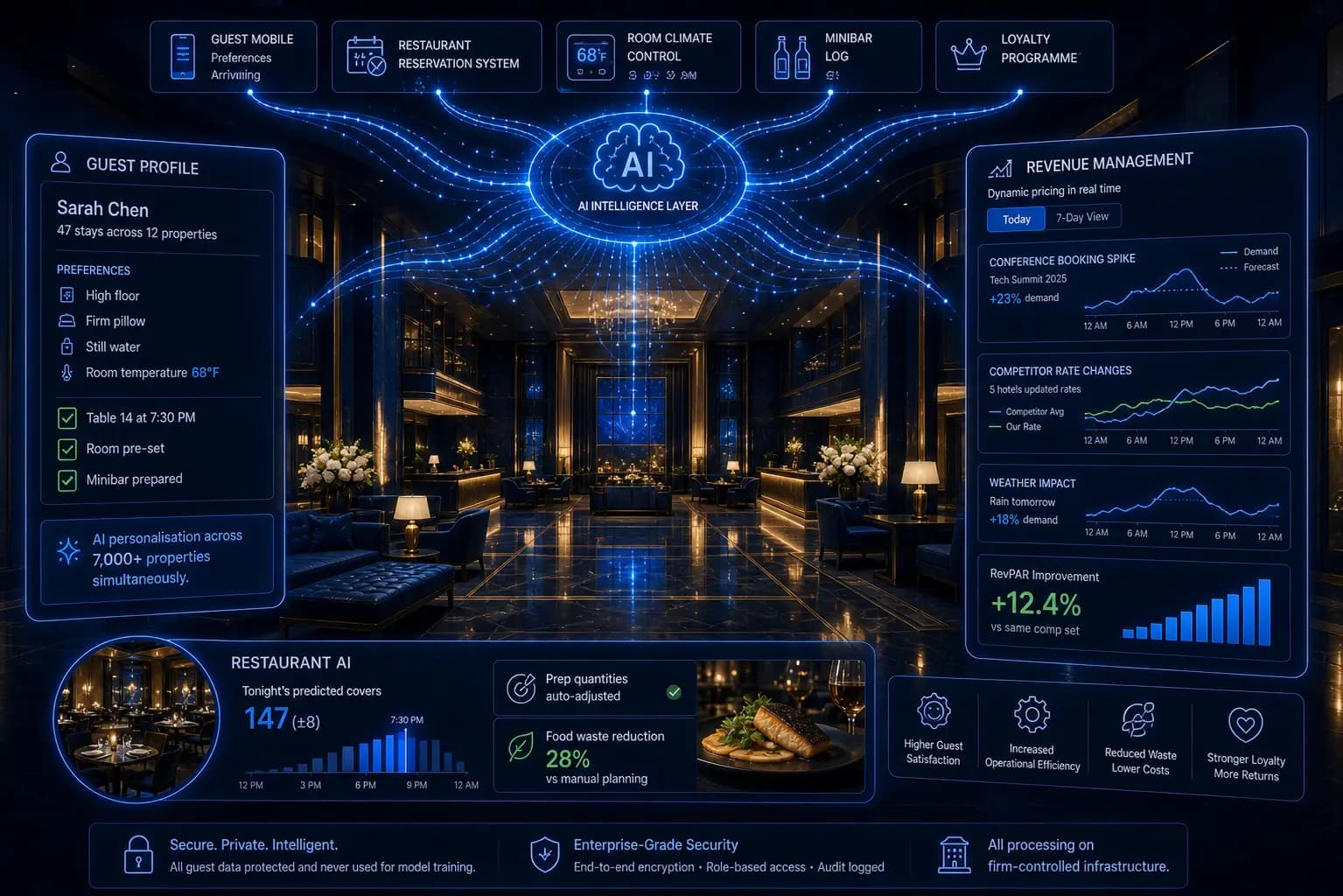
The difference between a five-star stay and a five-star experience is not the thread count. It is whether the hotel knew what you wanted before you arrived. A 400-thread-count cotton sheet is table stakes for a premium hotel — a room pre-set to your preferred temperature of 68°F, your favourite pillow type placed on the left side of the bed, your minibar stocked with still water rather than sparkling, and a dinner reservation at your usual table already waiting in the app — is the experience that creates the genuine emotional loyalty that drives repeat bookings, higher average spend, and positive reviews.
The challenge for enterprise hotel groups is not understanding this. It is operationalising it at scale. Personalising the stay for one known guest at a boutique property requires attentive staff who remember preferences. Personalising the stay for 10,000 guests simultaneously across 500 properties on any given night requires AI — a system that maintains each guest's preference profile, distributes it to the right operational teams before the guest arrives, and updates it with each new interaction. This is what AI for enterprise hospitality does: it converts the personalisation that was previously possible only at the boutique scale into a capability that enterprise hotel groups can deliver at every property, to every loyalty member, simultaneously.
The 6 Enterprise Hospitality AI Systems
AI Revenue Management and Dynamic Pricing
AI revenue management replaces the manual rate-setting and rules-based pricing that most hotel groups still use with a system that adjusts room rates in real time across multiple demand signals simultaneously. Traditional revenue management reviews a limited number of variables on a daily or weekly schedule — recent booking pace, competitive rates, and occupancy forecast. AI revenue management monitors all of these plus many more, continuously, and adjusts rates before human revenue managers would have identified the opportunity.
The compounding signals: booking pace by room category against same-period prior year, competitor rate changes across every OTA channel in real time, local event calendar (conferences booked 90 days out, sports events 6 months out, concerts 2 weeks out), weather forecasts affecting leisure demand, review sentiment affecting perceived value, and channel-specific demand patterns (corporate direct vs leisure OTA vs group). A conference detection model that identifies a booking spike pattern 90 days out and recommends a rate increase 2 weeks before traditional triggers produce a RevPAR improvement that pays for the AI investment many times over.
- Booking pace by room category vs same-period prior year and 3-year average
- Competitor rate changes across Booking.com, Expedia, and direct channels in real time
- Local event calendar — conferences, sports, concerts, public holidays up to 12 months out
- Weather forecasts — leisure demand correlation with weather patterns
- OTA ranking signals — search position correlation with rate competitiveness
- Length-of-stay pattern optimisation — controlling inventory for higher-value bookings
AI Guest Personalisation Engine
An AI guest personalisation engine builds an individual preference model for each guest from every data source the property has access to: booking history, past stay behaviour (room type selected, floor preference, check-in and check-out times), F&B spend patterns, spa and amenity usage, in-room requests (extra pillows, room temperature changes, minibar consumption), post-stay review content, and loyalty programme interactions. This model is applied 48–72 hours before each arrival to generate a preparation checklist for the operations team — the room assignment, the amenities to pre-stock, the dining reservations to pre-block, the personalised pre-arrival communication to send.
For enterprise hotel groups with large loyalty programmes, the personalisation advantage is compounding: a guest whose preferences are recorded from 12 prior stays across multiple properties receives the same recognition at a new property as at their home property. This cross-property consistency — the recognition of 'we know you' even in a city the guest has never visited with this brand — is the emotional loyalty driver that individual hotels and boutique properties cannot replicate without the same data infrastructure.
- Pre-selecting room assignment matching historical floor and view preferences
- Pre-stocking minibar and welcome amenities to recorded preferences
- Pre-setting room temperature, lighting, and entertainment preferences
- Pre-blocking preferred restaurant table and time if repeat diner
- Personalised pre-arrival email highlighting relevant on-property offers
- Generating staff briefing note for front desk — guest preferences, occasion context, VIP flags
AI Guest Messaging and Chatbots
Hotel guests communicate primarily through the messaging channels they already use — WhatsApp in Europe and Asia, SMS and iMessage in North America, in-app messaging for loyalty programme members. A hotel that responds to guest requests through the front desk phone or a clunky hotel app is already behind. AI hotel chatbots meet guests in their preferred messaging channels, responding instantly 24 hours a day to the full range of common guest interactions: pre-arrival questions about parking, check-in, amenities, and local recommendations; during-stay requests for room service, housekeeping, maintenance, and dining reservations; and post-stay feedback collection.
The 98% open rate on hotel messaging versus 20% for email is not a channel preference anecdote — it is the commercial case for meeting guests where they communicate rather than where the hotel wants them to communicate. At enterprise scale, a unified AI messaging layer handles guest communication consistently across thousands of properties in a hotel group while preserving individual property personality, language localisation, and brand tone.
- Pre-arrival: check-in time, parking, accessibility, pet policy, early check-in availability
- Concierge: local restaurant recommendations, transport booking, activity suggestions
- In-room: extra towels, pillow requests, room temperature, maintenance issues
- F&B: room service ordering, restaurant reservation modification, dietary requirements
- Post-stay: feedback collection, loyalty point queries, invoice requests
AI Restaurant Operations
Restaurant operations within hotels face a compounding demand uncertainty that standalone restaurants do not: in-house guest dining demand varies with hotel occupancy, group events, and the guest mix — a hotel full of conference attendees on a per diem has very different F&B patterns than the same hotel occupied by leisure weekend guests. AI restaurant demand forecasting integrates hotel occupancy data, reservation system data, historical cover patterns by guest mix, local event calendars, and weather to predict daily cover volume with significantly higher accuracy than manual chef estimation.
The waste reduction from more accurate demand forecasting is the most immediately measurable ROI: a restaurant that prepares 20% fewer portions than it would have under manual estimation, while maintaining service quality through better prep timing, reduces food cost at the direct margin level. For hotel groups with multiple F&B outlets per property across hundreds of properties, this is a substantial operational saving. AI also analyses menu item performance data — sell-through rate, margin contribution, preparation time, and guest review correlation — to inform menu engineering decisions.
- Hotel occupancy data by room type and guest segment
- Restaurant reservation system data (covers booked vs walk-in history)
- Historical cover patterns by day of week, season, and event type
- In-house group event schedules and banqueting commitments
- Local events driving walk-in traffic (nearby concerts, sport events)
- Weather — outdoor dining demand, spa demand correlation
AI Staff Operations and Task Routing
Housekeeping is the highest-labour-cost operation in most hotels, and it is traditionally scheduled by fixed rota rather than optimised by actual demand. AI housekeeping optimisation assigns rooms to housekeepers based on room occupancy patterns, guest check-out times, stay-over priorities, DND status, and maintenance flags — routing each housekeeper to rooms in an order that maximises rooms cleaned per shift while ensuring the highest-priority rooms (imminent arrivals, VIP guests, maintenance-flagged rooms) are addressed first. Predictive maintenance AI flags equipment approaching failure before it creates guest-facing service interruptions — an HVAC unit that fails during a heat wave at full occupancy is an exponentially more expensive problem than the same failure caught 2 weeks earlier during a routine maintenance window.
- Housekeeping route optimisation — rooms assigned in priority order based on arrival patterns
- Predictive maintenance — equipment sensor data flagging failures before they occur
- Labour demand forecasting — staffing levels optimised to occupancy and event schedule
- Task routing — guest requests routed to the nearest available staff member
- Shift scheduling — AI-generated schedules that meet labour regulations and demand
In-Room AI and Voice Assistants
In-room AI voice assistants — deployed on smart displays, tablets, or integrated room systems — give guests instant access to concierge-level information and service requests without picking up the phone or navigating a hotel app. 'What time does the spa open?' 'Can you book me a table at the restaurant for two at 7:30?' 'What are the checkout procedures?' 'Please have extra towels brought to my room.' 'Turn the lights to 40%.' These interactions, handled instantly and accurately at any hour, reduce front desk call volume, improve guest self-service satisfaction, and free front desk staff for the higher-value interactions that require genuine human engagement.
- Voice service requests — housekeeping, room service, maintenance, dining reservations
- Room control integration — lighting, temperature, curtains, entertainment
- Local recommendations personalised to guest profile and stated interests
- Property information — hours, facilities, services, policies
- Wake-up call scheduling and morning preparation reminders
- Check-out processing and invoice delivery by voice command
Which hospitality AI system delivers the highest ROI for your hotel group or restaurant chain?
Automely's hospitality AI consultation maps your current operations and identifies the highest-value first implementation. Book a free 45-minute call.
The Guest Data Flywheel — Why Enterprise Hospitality AI Compounds Over Time
The most strategically significant property of AI personalisation for enterprise hotel groups is the guest data flywheel. The same compounding dynamic that makes AI in education more effective over time — more interactions generating better models, which produce better outcomes, which attract more interactions — operates in hospitality at enterprise scale. The difference in hospitality is the competitive moat it creates: a hotel group with 10 million loyalty members generating interaction data across 5,000 properties has AI personalisation models that a 200-room independent hotel simply cannot replicate.
Each stay generates preference data
Room assignments, temperature adjustments, dining choices, spa bookings, amenity requests, review content, and check-in/check-out patterns — each data point refines the individual guest preference model.
More data produces more accurate personalisation
After 5 stays, the AI knows the guest's floor preference and pillow type. After 20 stays across multiple properties, it knows their dining time, preferred table location, spa treatment preferences, and the room amenities they actually use versus ignore.
Better personalisation drives higher satisfaction and repeat stays
Guests who experience the 'they know me' recognition — a room prepared to their preferences without asking, a restaurant reservation at their usual table, a pre-arrival message that references their past stays — have measurably higher satisfaction scores and significantly higher return visit rates.
More stays generate more data — the flywheel accelerates
Repeat guests generate richer preference models, which produce better personalisation, which drives more repeats. The enterprise hotel group that has been operating AI personalisation for 3 years has preference profiles for millions of loyalty members that are dramatically more accurate than profiles built from just 1–2 stays — creating a compounding loyalty advantage that compounds with every additional stay.
Enterprise hotel groups that implement AI personalisation now begin accumulating the loyalty data advantage immediately. The group that has 3 years of AI-enhanced preference data in 2029 has a measurably superior personalisation capability to one launching in 2029. As with the data flywheel in education, the advantage compounds from deployment date — not from technology maturity. The technology for enterprise hospitality AI is mature in 2026. The competitive advantage accrues from when you start.
Enterprise Hotel Groups vs Independent Properties — The AI Strategy Split
AI in hospitality creates fundamentally different strategic opportunities for enterprise hotel chains and independent properties. Understanding this split — and which AI investments make sense for which type of operation — prevents the most common hospitality AI mistake: an independent hotel investing in enterprise-scale AI infrastructure that does not generate returns at their volume, or an enterprise chain adopting boutique-scale tools that do not scale across their portfolio.
🏙️ Enterprise Hotel Groups (100+ properties)
- Guest data flywheel compounds across full portfolio — cross-property preference recognition
- Centralised AI revenue management optimises inventory across properties and channels
- Unified guest messaging AI delivers consistent brand experience at every property
- Group-wide demand forecasting predicts portfolio-level demand shifts before individual properties detect them
- Custom AI justified by scale — marginal personalisation improvements generate substantial absolute revenue
- Competitive advantage against boutique competitors who cannot replicate data volume
🏡 Independent Hotels and Boutique Properties
- Compete on human authenticity and local knowledge — AI as operational support, not competitive moat
- Off-the-shelf revenue management AI (Duetto, IDeaS, Atomize) provides sophisticated pricing without custom build
- AI chatbot via WhatsApp provides 24/7 response without front desk staffing cost
- AI restaurant demand forecasting reduces waste and improves labour scheduling at any scale
- In-room AI provides concierge capability that small staffing cannot sustain manually
- Focus AI on operational efficiency, not personalisation scale — the boutique advantage is human, not data
What AI Does Not Replace in Hospitality — The Human Elements That Still Define the Experience
Hospitality is, at its core, a human business. The emotional connection between a guest and a property — the warmth of a genuine welcome, the intuition of a skilled concierge who suggests exactly the right restaurant, the empathy of a front desk manager who resolves a complaint in a way that turns a negative experience into a story the guest tells positively — is not produced by AI. The most successful hospitality AI deployments in 2026 are consistently those that are designed to amplify human hospitality, not attempt to replace it.
The Arrival Moment
AI prepares the perfect arrival — the right room, the right amenities, the briefing note for the front desk. But the warmth of the welcome, the genuine recognition of the guest as a person rather than a profile, and the first impression of the property's personality are irreplaceably human. AI makes the arrival operationally perfect. Staff make it emotionally memorable.
Local Expert Knowledge
A concierge who has lived in the city for 20 years knows which restaurant to recommend for a couple celebrating an anniversary based on a 60-second conversation — reading body language, tone, and unstated preferences. AI can recommend based on review data and prior visits. Human concierge judgment reads the moment and the person.
Service Recovery
When something goes wrong — a room that was not ready, a maintenance issue, a disappointing meal — the guest's experience of the resolution depends almost entirely on the quality of the human response. AI can route the complaint to the right person faster. A skilled manager who listens genuinely and resolves with empathy converts a negative experience into loyalty. AI cannot do this.
Unanticipated Guest Needs
The guest who arrives looking exhausted and stressed after a delayed flight, whose body language suggests they need quiet and space rather than a cheerful welcome speech and an upsell offer — an attentive front desk agent reads this and responds accordingly. AI personalisation serves the recorded profile. Experienced staff read the present moment.
AI in hospitality should be designed to free staff from the operational administrative tasks — fielding repetitive queries, manually routing service requests, reviewing occupancy forecasts, manually checking competitor rates — so that staff time is concentrated on the guest interactions that require genuine human presence and judgment. The hotels that achieve the highest guest satisfaction scores with AI are not the ones with the most AI — they are the ones whose AI handles the operational infrastructure so thoroughly that staff spend proportionally more time on the human interactions where they are irreplaceable.
Implementation Sequence for Hotel Groups and Restaurant Chains
Start with the highest-frequency, most consistent guest interaction
For most hotel groups, this is either guest messaging (the highest volume of guest interactions, most of which are repetitive) or revenue management (the highest direct financial impact, measured in RevPAR). Revenue management AI generates the fastest measurable financial return and requires the least operational change management — it produces better rates, not different processes. Guest messaging AI generates the highest guest satisfaction improvement and the most visible operational change.
Audit your guest data sources and integration landscape before any AI build
AI personalisation is only as good as the guest data it can access. Most hotel groups have guest data distributed across: the PMS (property management system), the CRS (central reservation system), the loyalty programme database, the restaurant POS, the spa booking system, and the review management platform — with varying degrees of integration and data quality. Map these sources, identify what preference data is currently captured and where, and understand what PMS API access exists for new AI integrations before scoping personalisation AI architecture.
Deploy in a single property or market before the full estate
Whether deploying AI revenue management, guest messaging, or personalisation, begin with a single property or a cluster of properties in a single market. The limited deployment generates clean attributable performance data, identifies integration issues in a controlled environment, builds internal operational confidence, and produces the ROI case that justifies full-estate rollout. Multi-property simultaneous deployment of new AI systems creates change management complexity and confounded performance data that makes it difficult to identify what is and is not working.
Train staff on AI-assisted workflows before deployment, not during it
AI hospitality systems change how staff interact with guest information — a front desk agent who receives an AI-generated guest briefing note needs to know how to read it, what to trust, when to verify, and what their role is in the AI-assisted workflow. Staff who learn the new workflow at the same time they are learning it is live with real guests have worse outcomes than staff who have practised the workflow before deployment. Train front desk, housekeeping leads, and F&B managers on the AI-assisted workflow as the deployment's final pre-launch step.
Measure guest satisfaction impact alongside financial metrics at 90 days
Revenue management AI generates clear financial metrics: RevPAR improvement, ADR (Average Daily Rate) change, and occupancy. Guest messaging and personalisation AI require guest satisfaction metrics alongside financial ones: NPS change, review score movement, repeat booking rate change, and direct booking conversion rate. At 90 days post-deployment, document both dimensions. The combination — financial impact and satisfaction improvement — is the business case that funds estate-wide rollout and subsequent AI system additions.
Building Hospitality AI with Automely
Automely's AI agent development, generative AI development, and AI integration services cover the full stack of hospitality AI implementations — guest personalisation engines integrated with PMS and loyalty programme data, AI chatbots trained on property-specific knowledge deployed across WhatsApp and in-app messaging, restaurant demand forecasting with occupancy and reservation system integration, revenue management AI, and staff operations routing systems.
Our hospitality AI implementations are designed for enterprise scale from the start: centralised guest profile architecture that distributes preference data to individual properties before arrival, PMS API integration with the major systems (Opera, Agilysys, Mews, Cloudbeds), loyalty programme data integration, and the multi-language and multi-property configuration that enterprise hotel groups require. For restaurant chains and hotel F&B operations, our demand forecasting implementations connect occupancy, reservation, event, and weather data into a unified forecast that drives prep quantity decisions and labour scheduling.
Browse our case studies, read client testimonials, and explore our full AI services portfolio including AI chatbot development, AI consulting services, and SaaS development for hospitality technology products. The guest data flywheel that makes enterprise hospitality AI compound over time closely mirrors the data flywheel in AI education — both create compounding competitive advantages from accumulated interaction data.
Ready to build the personalisation capability that makes your guests feel known at every property?
Book a free 45-minute hospitality AI consultation. We will map your guest data sources, identify your highest-ROI first system, and scope the architecture.