


The Math Most CTOs Get Wrong
Most decision-makers evaluating in-house AI development versus outsourcing make the same error. As Interexy's analysis puts it directly: "Most CTOs open Excel, type '$180K salary' on one line and '$120/hour agency' on another, and call it a day. That's not math. That's just hoping things work out." The salary-to-hourly-rate comparison captures one variable — the most visible one — and ignores every variable that actually determines whether in-house is cheaper: recruiting cost, ramp-up time, infrastructure, attrition, management overhead, and the opportunity cost of delayed deployment.
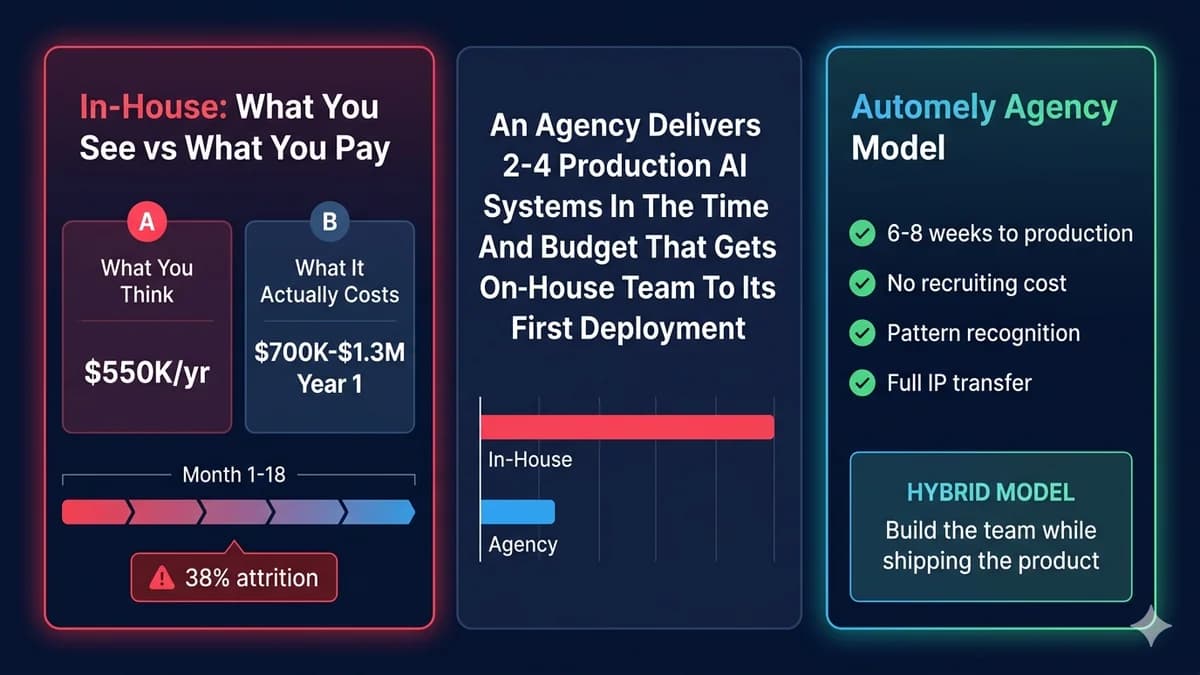
When you run the complete calculation — all-in cost per engineer, recruiting fees, 2-4 months of ramp-up at partial productivity, infrastructure, and the 38% annual attrition rate that makes the calculation repeat — a minimum viable in-house AI team of three people costs $700,000-$1,300,000 in Year 1. Before a single line of production AI code is written. Specialist AI agencies deliver in 6-8 weeks.
This guide does the math honestly — including the cases where in-house is genuinely the right answer. Because it is sometimes right. The mistake is choosing the wrong model at the wrong stage.
What an In-House AI Team Actually Costs in 2026
You cannot build production AI systems with one person — the scope is too broad. A minimum viable in-house AI team requires at least three roles. Here are the 2026 market rates, sourced across US and European markets:
| Role | US Base Salary | US All-In (+ benefits 25-30%) | EU Base (€) | EU All-In |
|---|---|---|---|---|
| Senior ML/LLM Engineer | $185K-$250K | $240K-$325K | €120K-€180K | €150K-€225K |
| Data Engineer | $150K-$200K | $195K-$260K | €90K-€140K | €115K-€175K |
| MLOps / Backend Engineer (AI) | $160K-$220K | $208K-$286K | €100K-€160K | €125K-€200K |
| AI/ML Engineering Manager | $200K-$280K | $260K-$364K | €140K-€220K | €175K-€275K |
| 3-Person Team (no manager) | $495K-$670K base | $643K-$871K all-in | €310K-€480K base | €390K-€600K |
| 4-Person Team (with manager) | $695K-$950K base | $903K-$1.24M all-in | €450K-€700K base | €565K-€875K |
The ML talent market is described as "brutal" across every 2026 analysis of this decision. Big tech offers €400,000+ total compensation packages. The top 10% of AI talent — engineers who have shipped production AI systems, not just trained models in notebooks — rarely appear on job boards. They are recruited through networks, referrals, and aggressive compensation that includes $50,000-$200,000 signing bonuses at top-tier companies. If your company, location, and compensation cannot compete with Google, Meta, and well-funded AI startups, you are not recruiting from the top 10%. You are recruiting from the pool that top-tier companies declined. That is a real and honest constraint that most in-house AI hiring discussions omit.
The 6 Hidden Costs That Make In-House More Expensive Than the Salary
The salary table above captures the most visible cost — but in practice, the hidden line items add another 40-80% on top of base compensation. These six are the costs that determine whether the in-house model is actually cheaper than an agency, and they almost never appear in the original CTO spreadsheet.
1. Recruiting Cost — $30,000-$65,000 Per Hire
Agency recruiter fees run 20-25% of first-year salary — that is $37,000-$62,500 per senior AI hire. Internal recruiting time adds $9,000-$12,000 in opportunity cost (60-80 hours of senior engineering manager time at loaded rates). Plus signing bonuses ($10,000-$50,000 for senior AI engineers), interview process overhead, and background checks. LinkedIn data: average time-to-hire for ML engineering roles is 45-60 days; senior and specialist roles (RAG architects, multi-agent engineers, MLOps leads) take 6-9 months.
2. Ramp-Up Dead Cost — $50,000-$100,000 Per Engineer
Even experienced AI engineers need 2-4 months to understand your data architecture, legacy systems, business domain, and quality standards before producing meaningful results. During this period you are paying full salary for 30-50% output — $25,000-$60,000 in effective dead cost per engineer. On a 3-person team: $75,000-$180,000 in ramp-up dead time. Groovy Web's analysis: if the first hire takes 5 months to find and 4 months to ramp, you have spent 9 months and $250,000+ before writing production AI code.
3. Infrastructure and Tooling — $3,000-$15,000 Per Month
GPU compute for model training and inference, API costs for OpenAI or Anthropic, software licences, data pipeline infrastructure, monitoring, experiment tracking, and MLOps tooling. Interexy's analysis: if you are running your own fine-tuned LLM, infrastructure alone runs $6,000-$35,000 per month before paying a single engineer. With outsourcing, these costs are typically included in the agency rate or clearly listed upfront — and consumed only during the project, not as an ongoing operational commitment.
4. Continuous Retraining Overhead
AI capabilities evolve faster than almost any other engineering domain. A model architecture that was state-of-the-art in 2024 may be suboptimal in 2026. Keeping your in-house team current requires ongoing training, conference attendance, and time for engineers to experiment and learn — typically consuming 15-20% of engineering time that does not appear in any project plan. This is the "skill obsolescence risk" that multiple 2026 analyses cite as a unique challenge for in-house AI teams that agencies address by nature of their multi-client exposure.
5. Management and Technical Leadership Gap
AI engineers need technical leadership that understands AI architecture — not generic engineering management. If you do not already have an experienced AI technical lead, your team will make poor architectural decisions, lack direction on model selection and evaluation, and be susceptible to "Jupyter notebook success, production failure" — building impressive demos that never reach users because there is no MLOps expertise to deploy them. Hiring an AI/ML Engineering Manager adds $260,000-$364,000 all-in annually. Not hiring one means your AI engineers direct themselves — and often optimise for technical elegance over business outcomes.
6. Opportunity Cost of Delayed Deployment — 6-9 Months
Every month without production AI is a month competitors compound ahead. McKinsey's 2025 State of AI report: businesses using AI in sales and marketing saw 5-10% revenue growth. An AI feature that could have been live in month 3 with an agency but launches in month 15 with in-house hiring has 12 months of competitive disadvantage built in — before accounting for customer acquisition, market positioning, and team morale from watching a competitor move faster. This cost does not appear on any spreadsheet but is consistently the largest real cost of the wrong hiring decision.
Pricing both options for your specific team size and project scope — want the honest total cost comparison including all the hidden costs above? Automely provides this analysis free.
Free 45-minute consultation. We run the real cost comparison for your situation — in-house all-in vs Automely retainer — including timeline, IP transfer, and when in-house genuinely makes more sense than outsourcing.
The Attrition Cascade — The Cost Nobody Puts in the Model
The 38% annual attrition rate for AI engineers (Interexy, multiple 2024-2025 studies) means that on a team of three, statistically one person leaves every 10 months. The cascading cost of that single event — a cost almost never included in the in-house cost model — is substantial:
⚠️ The Cost of One AI Engineer Leaving — The Cascade Most Models Ignore
Notice Period: 2-4 Weeks at 30% Output
Departing engineer mentally disengages. Context transfer is rushed. Critical decisions get deferred.
Seat Vacancy: 4-6 Months Empty
Recruiting replacement takes time. Remaining 2 engineers absorb the load, reducing their output 20-30%.
Knowledge Loss: Partially Unrecoverable
The departing engineer takes understanding of your prompt designs, model tuning decisions, data pipeline quirks, and architectural reasoning. Code is in Git. Context is gone.
New Hire Ramp-Up: 3-6 Months at 30-50% Productivity
Replacement engineer needs the same context-building cycle as original hire. Dead cost repeats.
Morale Contagion: Remaining Engineers Explore Options
AI engineers who see colleagues leave for higher-paying roles at Big Tech begin evaluating their own options. Second and third attrition events become more likely.
Total one-attrition-event cost: $125,000-$237,000 plus unquantifiable knowledge loss — on a team that statistically experiences this every 10 months. On a 3-year model, that is 3-4 attrition events at $375,000-$950,000 in accumulated attrition cost, none of which appears in the original hiring plan.
What the Agency Model Actually Delivers
The agency model eliminates the specific costs that make in-house so expensive at the early stages of AI adoption. No recruiting cost, no ramp-up dead time, no attrition event, no institutional knowledge loss when a person leaves. These are not theoretical advantages — they are structural ones, because an agency's value to you does not depend on any single individual not leaving.
The pattern across 200+ projects that Groovy Web documents: an agency typically delivers 2-4 production AI systems in the time and budget that gets one in-house team to its first deployment. Tectome's UK market data shows the average time from kickoff to first working production deployment is 2-8 weeks for MVP AI agents. ZTABS's analysis: agencies can begin work in 1-2 weeks; the in-house hiring pipeline alone takes 6+ months.
Side-by-Side Cost Comparison
Putting the in-house and agency models next to each other with the same Year 1 framing makes the structural cost difference unmistakable. Both columns assume a comparable scope of work — a minimum viable AI delivery capability — so the totals reflect the real cost of getting to production through each path.
Year 1 Realistic Model
3-person minimum viable team, US market
Year 1 Realistic Model
Dedicated engineer retainer, AI-first delivery
*AIDOLS research: outsourcing AI development is typically 40-60% cheaper than building in-house for projects under 12 months. Savings compress toward breakeven at 18-24 months for stable, growing in-house teams.
When In-House Is Genuinely the Right Answer
This guide is written from an agency perspective — Automely is an outsourced AI development firm. The honest acknowledgment of when in-house is right is the most important section for a buyer to read, because choosing the wrong model at the wrong stage is expensive in both directions.
✓ In-House When: AI Is Your Core Product
If your competitive moat is the model — if you are building a foundation model, an AI-native product where the training data and architecture are your differentiator, or a service where the AI quality itself is what customers pay for — you must own the talent. As AIMakers puts it: "Iterating on a model that is your product happens daily, not quarterly. Outsourcing that is outsourcing your moat." Custom AI system builders, AI-native SaaS companies, and businesses where the model IS what they sell require permanent in-house AI capability. An agency cannot own your most strategic intellectual asset for you.
✓ In-House When: Data Cannot Leave Your Environment
Healthcare organisations with HIPAA requirements, financial services firms under FCA data governance rules, government and defence contractors under classification requirements, and legal firms with client confidentiality mandates may face regulatory or contractual restrictions on sharing data with external parties. When the data that powers your AI system genuinely cannot be handled by an external firm — even under NDA and data processing agreements — internal engineers with controlled access are the only viable path. Note: many agencies now operate within client environments under strict data agreements, which resolves this in many cases. Evaluate the specific regulatory constraint before assuming it mandates in-house.
✓ In-House When: Multi-Year Programme with Growing Scope
The breakeven for in-house vs outsourced AI development is 18-24 months (AIDOLS, ZTABS, multiple analyses). If your AI roadmap genuinely extends beyond 24 months with continuous, growing scope — and you can attract and retain the talent — in-house becomes cost-effective in Year 2 and compounds beautifully in Year 3. The foundation built in Year 1 is expensive. The productivity in Years 2 and 3 from a stable, experienced team that knows your systems and domain deeply is the dividend.
✓ In-House When: You Can Compete for Top Talent
This is the critical qualifier that most in-house advocates omit. Attracting and retaining senior AI engineers requires competing with Big Tech compensation (€400K+ packages), brand prestige, and technical environment. If your company, location, compensation structure, and technical culture cannot compete — you are not building the in-house team you are imagining. You are building the team that was available, which is structurally different from the team that is capable of producing what you need.
✓ Agency When: Everything Else — Especially Early Stage
If you are building your first AI feature, testing AI viability before scaling, adding AI to an existing product, or operating with a timeline that cannot absorb 9-18 months of hiring and ramp-up before seeing results — the agency model is almost always the financially and strategically superior choice. You validate ROI before committing to $700K+ in permanent hiring. You get pattern recognition from a team that has solved your problem category before. You build faster and ship earlier. And you can always hire later — with the knowledge of what the right hire looks like. You cannot get those first months back. See the hidden cost comparison for Upwork vs specialist agency for the freelance alternative analysis.
The Hybrid Sequence — Build the Team While Shipping the Product
The model that most experienced AI leaders recommend in 2026 is not a binary choice — it is a deliberate sequence. The insight from Inventiple, Tectome, and Innovate247, all based on dozens of client projects: "Agency for exploration and shipping. In-house for exploitation and scaling. The agency de-risks the investment and establishes the architecture. You hire in-house to scale something already proven." The sequence:
Agency builds and ships V1
Architecture design, MVP development, production deployment. Working AI in production in 6-8 weeks. Use live product data to validate which AI capabilities drive retention and revenue. Decide what to build next based on data, not assumptions.
Hire your first AI engineer who shadows agency
The critical timing: hire during the agency's final build phase, not after. First in-house engineer shadows the agency team, learns the codebase, understands architectural decisions, and is operational before handoff. Hire with the knowledge of what good looks like — because you have now seen it in production.
Structured handoff with documented knowledge transfer
Write "Knowledge Transfer" into the agency contract as a paid milestone. Build a Prompt Registry (every prompt has metadata: model version, temperature, expected output, edge cases where it fails). Internal engineer takes day-to-day ownership. Agency available for architecture reviews and spike work. The documented handoff takes clean transfer probability from 30% to 85%.
Agency on retainer for spike work and new initiatives
New AI initiative, integration with a new system, urgent feature request, capacity overflow — the agency stays on retainer rather than being hired for each project from scratch. Your in-house engineer focuses on maintaining and iterating what works. Agency provides specialist depth for the next build. Gradually internalise as your in-house team grows with proven capability benchmarks to hire against.
Groovy Web's projection for businesses that follow the outsource-first, hybrid-sequence model: $700,000-$1,200,000 in Year 1 savings compared to the in-house-only model — plus 6-9 months of time-to-market advantage over competitors who were still hiring while you were shipping. The sequence is the strategy.
Ready to discuss the hybrid model for your specific AI roadmap — what the agency builds in months 1-4, when and how to bring capabilities in-house, and what the Automely retainer looks like for your scope? Free 45-minute consultation.
We run the numbers honestly. If in-house is the right answer for your situation, we will tell you. If the hybrid sequence makes more sense, we will map exactly what that looks like — with realistic cost and timeline projections for each phase.