


The Distinction That Actually Matters
In 2026, every development agency is "AI-powered." This is approximately as useful a differentiator as "uses computers." 60% of all new code written in 2026 is AI-generated. 84% of developers use AI tools daily. 92% of US developers have adopted AI coding practices. The tools are everywhere. The question that actually matters is not which tools an agency uses — it is how those tools are embedded in their operating model, and what they do to the delivery process.
There is a meaningful distinction between two types of agencies, and it is worth being direct about it:
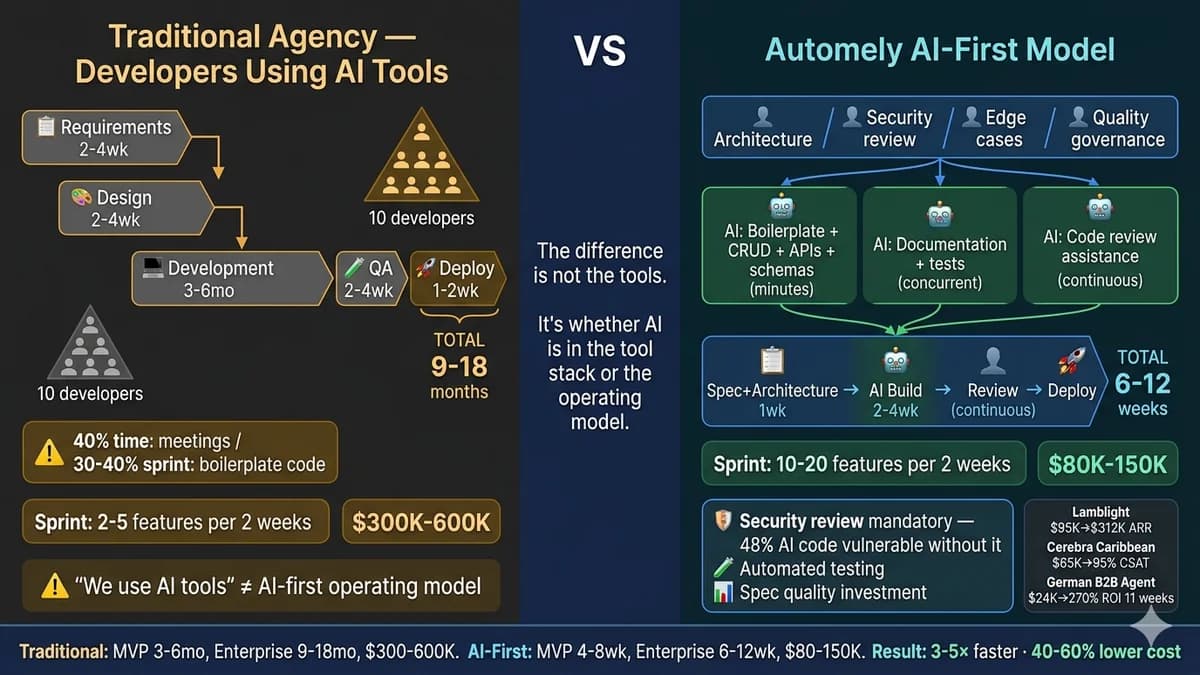
Traditional agencies using AI tools have the same delivery model they always had — requirements, design, sprint-based development, QA, deployment — but with developers using GitHub Copilot or Claude Code to write some code faster. The process is identical. Some individual tasks are faster. The timelines, team structure, coordination costs, and delivery experience remain structurally unchanged.
AI-first development companies have redesigned the entire delivery model around AI. AI agents handle 70-80% of implementation work — boilerplate, CRUD operations, API endpoints, database schemas, standard component patterns, test generation, documentation. Senior engineers focus exclusively on architecture decisions, edge cases, client-specific business logic, and quality governance. The result is a fundamentally different delivery velocity, not because any individual task is slightly faster, but because the entire operating model is rebuilt around what AI does well and what humans do better.
Automely is the second type. This guide explains what that specifically means — step by step, with the data on what the difference produces in delivery timeline, cost, and quality — and the three questions every buyer should ask before hiring any AI development company in 2026.
How Traditional Development Agencies Work — And Where the Time Goes
Understanding the traditional delivery model specifically helps clarify what AI-first is not replacing — and what it is. Traditional development is not broken. It is well-understood, professionally managed, and appropriate for certain project types. The issue is that for most standard software projects in 2026, it is unnecessarily slow and expensive given what AI-first delivery can now achieve.
Sequential Process, Human Execution
- Requirements gathering: 2-4 weeks of meetings, documentation, stakeholder alignment, sign-off rounds
- Design phase: 2-4 weeks of UX/UI, wireframes, stakeholder review cycles
- Sprint-based development: 3-6 months — developers write every line of code including boilerplate, CRUD, APIs
- QA phase: 2-4 weeks of manual and automated testing after development completes
- Deployment and handoff: 1-2 weeks
- Boilerplate and standard code: 30-40% of total development time on patterns that repeat across every project
- Coordination tax: 10-person team spends 40% of time in communication (meetings, Slack, code reviews, standups)
- Total timeline for enterprise application: 9-18 months
Parallel Execution, Governed by Seniors
- Spec and architecture: 1 week — senior engineers define architecture, data models, and technical boundaries
- AI implementation: 2-4 weeks — AI agents generate boilerplate, CRUD, API endpoints, database schemas, standard components concurrently
- Continuous senior review: throughout — all AI-generated code reviewed by senior engineers before it ships
- Integrated QA: automated testing pipelines run concurrently with development, not after it
- Deployment: overlaps with final review, not a separate sequential phase
- Boilerplate: generated in minutes, not weeks — the 30-40% of traditional time eliminated
- Coordination: 2-person AI-first team spends 10% of time in communication vs 40% for a 10-person traditional team
- Total timeline for enterprise application: 6-12 weeks
Automely's AI-First Model — What It Actually Looks Like
The distinction between "developers using AI tools" and "AI-first operating model" is one that Groovy Web — who has run both models across 47 comparable projects — articulates precisely: "AI-First is not 'developers using AI tools.' It is a fundamentally different operating model where AI Agent Teams do 70-80% of the implementation work, and senior engineers focus on architecture, edge cases, and quality assurance."
Automely's delivery model operates on this architecture. A typical project engagement begins with a 7-day onboarding to first sprint — not months of discovery documentation before any code is written. What that sprint contains:
- AI agents handle implementation: generating boilerplate code, CRUD operations, API endpoints, database schemas, authentication flows, standard UI components, test stubs, and documentation. These tasks, which consume 30-40% of traditional project time, are completed in hours or days rather than weeks.
- Senior engineers own architecture: every project starts with a senior engineer defining the data model, API contracts, security boundaries, and technical decisions that AI agents will execute within. The architecture is human — the execution is AI-accelerated.
- All AI-generated code is reviewed: every AI-generated file passes through senior engineer code review before it is committed. This is non-negotiable — not because AI is unreliable but because 48% of AI-generated code contains security vulnerabilities when deployed without review governance.
- Security scanning is integrated: automated security scanning runs as part of the CI/CD pipeline, not as a post-development audit. Vulnerabilities are caught before they ship, not discovered in production.
- Client-specific logic is human-owned: the business rules, edge cases, and domain-specific logic that make your product different from a generic implementation are designed and implemented by senior engineers. AI handles the patterns; engineers handle the uniqueness.
Traditional development sprint (2 weeks, 5-developer team): 2-5 features shipped, significant time on boilerplate and coordination. AI-first sprint (2 weeks, 2-person AI-first team): 10-20 features shipped, boilerplate eliminated, coordination minimal. This is not a marginal productivity gain — it is a structural output change that compounds across every sprint of a project.
Where the Speed Comes From — The Specific Sources
The 3-5× delivery speed advantage of AI-first development comes from eliminating specific, identifiable sources of waste in traditional development — not from doing the same things faster.
Boilerplate Elimination
30-40% of traditional development time is spent on boilerplate code — CRUD operations, API endpoints, database schemas, authentication flows, standard component patterns. These are well-understood, high-repetition tasks that AI agents generate in minutes. Eliminating this single time sink compresses 3-6 month development timelines by weeks. On a $300K project, this represents $90,000-$120,000 in eliminated labour cost.
Coordination Tax Reduction
A 10-person traditional development team spends approximately 40% of its total time in coordination activities — meetings, Slack discussions, code review cycles, standups, documentation handoffs. A 2-person AI-first team (senior engineer + AI agents) spends approximately 10%. This is not a productivity improvement per person — it is a team structure change that eliminates the coordination overhead that scales with team size.
Task-Level Speed on Coding Work
GitHub Copilot research (MIT/Microsoft): 55% faster task completion on specific coding tasks for developers using AI assistance. Longitudinal studies across teams: 21-36% faster on well-scoped programming tasks after the adoption learning curve (approximately 11 weeks). Individual developer speed gains compound across the team in an AI-first model where every engineer is using AI assistance optimally.
Concurrent Execution vs Sequential Phases
Traditional development runs phases sequentially: requirements → design → development → QA → deployment. AI-first development runs many of these concurrently. While AI agents are generating implementation code, senior engineers are reviewing and testing earlier outputs. While testing runs, documentation is generated automatically. The timeline compression is not just about each phase being faster — it is about phases overlapping that previously could not.
Want to see what your specific project would look like in Automely's AI-first model — timeline, team structure, cost, and delivery milestones — compared to a traditional agency approach? Free 45-minute strategy session.
We run the comparison for your specific project scope. You leave with a realistic AI-first delivery plan and the honest assessment of where the model saves time and where it requires additional governance investment.
The Quality Question — The Honest Answer
Any AI development company that does not address the quality risks of AI-generated code is either unaware of them or not being honest with you. The data on AI code quality is mixed, and understanding it is essential for evaluating any AI-first development claim.
| Risk | What the Research Shows | Automely's Governance Response |
|---|---|---|
| Security vulnerabilities | 48% of AI-generated code contains security vulnerabilities without review. 40% of GitHub Copilot-generated programs flagged for insecure code. | Mandatory senior engineer security review on all AI-generated code. Automated security scanning in CI/CD pipeline before any code ships. |
| Delivery stability | Google DORA 2024: AI tools can increase delivery instability by 7.2% when added without governance changes. Teams can face 41% rise in bugs with excessive AI code. | Governance maturity is built into the delivery model from day one. Review queues, QA, and integration are resourced proportionally to AI code volume. |
| Incomplete test coverage | AI frequently generates tests that run without errors but don't validate meaningful behaviour. Missing validation logic and error handling are common patterns. | Senior engineers define the test coverage requirements. AI-generated tests are reviewed for behavioural validity, not just execution success. |
| Review overhead | Faster coding shifts bottleneck to code review. Pull request volume increases. Without scaled review capacity, overall delivery velocity doesn't improve. | Senior engineer review is staffed as a core delivery function, not an afterthought. Review capacity scales with AI output volume. |
| Spec quality dependency | AI amplifies both good and bad architectural choices by 10-20×. Garbage specs produce garbage output, faster. Input quality determines output quality. | Senior architects spend proportionally more time on specification clarity than in traditional development — because the investment multiplies across AI-generated implementation. |
AI-first development is not appropriate for every project type. Novel algorithm design, deep research and development, highly regulated systems where compliance review pace dominates, and projects where the business logic is so unique and complex that AI agents cannot assist meaningfully — these are better served by traditional development or highly specialised expert teams. 80-90% of standard software projects benefit from AI-first development (Groovy Web, 47-project data). The remaining 10-20% do not, and any AI development company that claims otherwise is overstating the case.
Automely Client Results — The Actual Numbers
Every AI development company should be able to produce verified client outcomes — not theoretical projections but actual delivery timelines, costs, and measurable results from completed projects. Here are three from Automely's client portfolio, ranging from consumer app to enterprise AI agent:
3 Questions to Ask Any AI Development Company Before Hiring
The claim "we're an AI-first development company" is easy to make and difficult to disprove without knowing what to ask. These three questions separate genuine AI-first operating models from traditional agencies with updated marketing copy. Any AI development company worth hiring should have clear, specific answers to all three.
See our companion checklist on what to look for in an AI development company before hiring in 2026 for the eight criteria — beyond the three questions above — that separate real AI development companies from pitch-deck sellers when you are running a final evaluation.
Ready to compare Automely's AI-first model against your current agency or internal development plan — with a specific scope, realistic timeline, and honest cost breakdown for your project?
Free 45-minute strategy session. We review your project scope, give you a realistic AI-first delivery plan, and answer the three questions above with Automely-specific answers — not marketing language.