


How to Use This Guide
This comparison is not about which model is universally better. Both are genuinely right in the right context. Freelance AI developers are the correct hire for specific, scoped tasks where cost efficiency and speed to start matter more than continuity and accountability. Dedicated developers are the correct hire when the project carries production risk, evolving scope, or any dependency on institutional knowledge that one person disappearing could destroy.
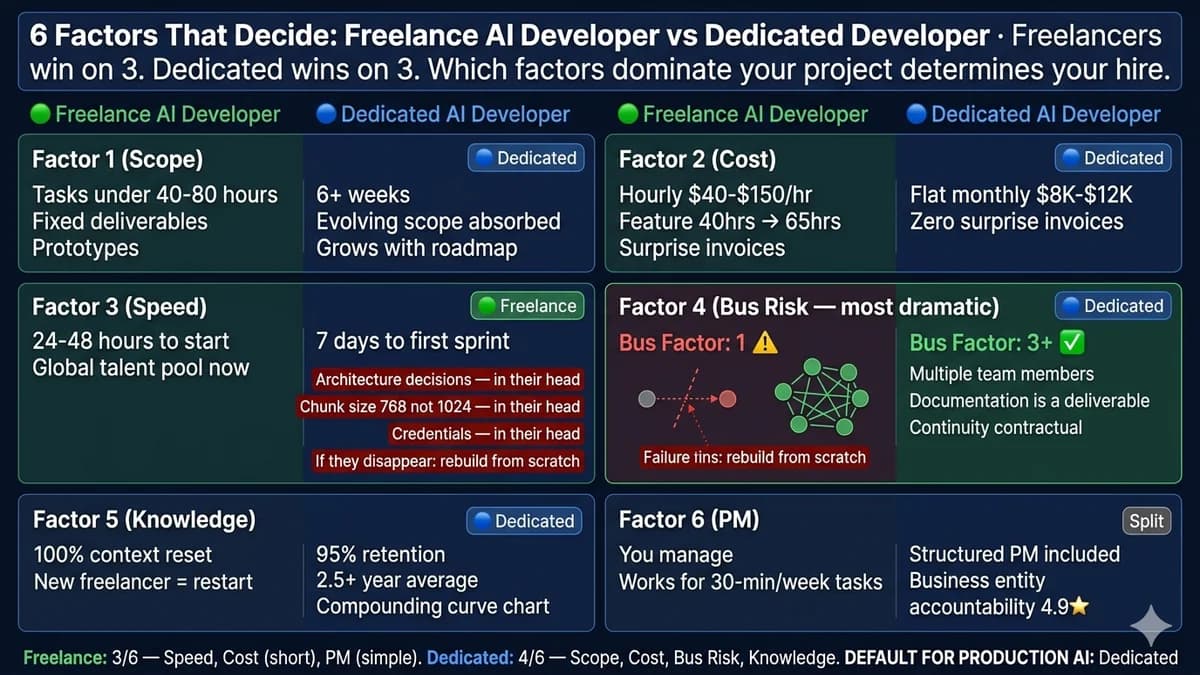
Six factors are scored below. Freelancers win three of them. Dedicated developers win the other three. The right hiring decision is determined by which factors matter most for your specific project. The same decision-maker evaluating two different projects — a quick proof-of-concept and a production customer service agent — should reach different conclusions for each.
Is this project a short, well-scoped task — or an ongoing capability? A task ends. A capability grows. If the work is a task (specific deliverable, clear acceptance criteria, under 40-80 hours), freelance is usually right. If the work is a capability (AI development your business will iterate, maintain, and scale), dedicated is almost always right. This single distinction predicts the right hiring model more accurately than any other factor.
Factor 1: Project Scope and Duration
The first and most decisive factor is whether the work has a defined end or an evolving roadmap. Short, scoped tasks favour freelance. Anything that will keep moving — feature additions, monitoring, retraining, integration updates — favours dedicated. The split here is sharp because AI development almost never stays static after launch.
- Right for short, clearly defined tasks under 40-80 hours with fixed deliverables and clear acceptance criteria
- Prototyping, proof-of-concept, single model integration, specific data pipeline task, prompt engineering for a defined use case
- Pre-seed stage: proving a concept quickly does not need scalable infrastructure — freelancer builds the raw demo faster and cheaper
- When requirements will not evolve: locked spec with clear acceptance criteria means freelancers execute cleanly without scope creep billing
- Right for projects spanning 6+ weeks with evolving requirements — which describes almost all production AI development
- Ongoing AI development: model monitoring, retraining, feature additions, integration updates — dedicated developers grow with your roadmap
- Complex AI projects: RAG systems, multi-agent architectures, AI-powered applications requiring data pipelines, security, compliance — multiple specialists working cohesively
- Scope changes absorbed within monthly hours without rate renegotiation or billing surprises
Factor 2: Cost Predictability
The headline rate is misleading on both sides. Freelance hourly rates look cheaper but compound through hours variance, revision cycles, and your management overhead. Dedicated monthly rates look heavier but absorb scope changes inside the retainer and let your CFO budget with certainty. The total-cost math, not the per-hour math, is what decides this factor.
- Hourly rates $40-$150/hour on platforms like Upwork; AI/ML specialists with LLM and agent experience command $120-$200+/hour
- Variable monthly totals: a feature estimated at 40 hours can balloon to 65 hours across revision cycles, scope evolution, and communication overhead
- Genuinely cheaper for truly short, scoped tasks under 40 hours where hours are fixed and deliverables are clear
- Hidden costs: your management time, revision cycles from quality variance, re-hire and context-transfer costs when a freelancer finishes and a new one starts
- Flat monthly rate — typically $8,000-$12,000 per developer per month through specialist agencies (StepTo 2026 data) — budget with certainty
- Zero surprise invoices: scope changes happen within allocated hours without rate renegotiation
- Predictable annual planning: CFO can forecast AI development cost precisely versus variable hourly billing that compounds with project complexity
- Total cost comparison: for projects over 6-8 weeks, flat monthly almost always cheaper than variable hourly when accounting for scope creep, revision cycles, and management overhead
Trying to price your specific AI project across both models? Free 45-minute consultation includes the honest cost comparison for your scope and budget — including where freelance is genuinely the better choice.
We run the numbers for your situation. If freelance is right, we will say so. If dedicated is right, we will show you exactly why and quote the retainer.
Factor 3: Speed to Start
This is the single factor where freelance wins cleanly — and it is the factor most buyers overweight. Freelancers begin in 24-48 hours; dedicated engagements take 1-2 weeks to set up. That difference matters enormously for a funding deadline or investor demo, and very little for a production AI system that will run for a year.
- Can begin within 24-48 hours of hire decision — minimal onboarding overhead, direct start on tasks
- Global talent pool: specialists in any timezone available today with no procurement process
- No contract negotiation for standard engagements on Upwork or Toptal — straightforward terms, immediate commencement
- Critical advantage when you need a proof-of-concept in two weeks for a funding deadline or investor demo
- 1-2 week setup for structured engagement: onboarding, codebase access, systems access, communication setup — Automely's 7-day onboarding to first sprint is still dramatically faster than in-house hiring (3-6 months)
- The setup investment pays back quickly: dedicated developers are productive from Week 1 without the context-building cycle that freelancers restart on every engagement
- Worth it for any project over 6 weeks — the 1-2 week setup cost is amortised within the first month by the continuity advantage
Factor 4: Bus Factor Risk
Bus factor is the single largest blind spot in AI hiring decisions. Every freelance engagement carries bus factor 1 by definition — one person holds the architectural context, the model parameter decisions, the credentials, the edge case handling. For a 20-hour prototype, that risk is acceptable. For a production AI system, it is the most common failure mode in the category.
- One person carries all context: architectural decisions, why specific model parameters were chosen, how edge cases are handled, where credentials are stored, how the deployment pipeline works
- If the freelancer disappears — new opportunity, personal circumstances, scope exceeds estimate — you lose all that context, not just the coding hours
- The knowledge loss problem: if your RAG pipeline's chunk size is 768 and not 1024, and the person who knows why has left, that architectural decision cannot be safely changed without a rebuild
- Platform dispute processes provide limited recourse for partially completed AI systems — the replacement cost is typically a full restart
- Multiple team members carry context — documentation is maintained as a deliverable, not an afterthought
- Architectural decisions are recorded: decision logs, prompt registries, infrastructure documentation — the "why" is captured, not held in one person's head
- Continuity is contractual: Automely is a business entity with accountability that individual freelancers cannot provide — if delivery stalls, there is a company responsible
- IP and access credentials are explicitly yours from day one — not stored in a freelancer's personal accounts or local machine
Factor 5: Institutional Knowledge and Continuity
AI systems are not static software. They drift, require monitoring, and need retraining. The economics of institutional knowledge are particularly pronounced here because domain complexity is high and edge cases are numerous. A dedicated developer in Month 6 is dramatically more productive than a freelancer starting fresh in Month 7. The knowledge does not transfer — it has to be rebuilt.
- 100% context reset between engagements — every new freelancer starts from zero on your codebase, domain, and quality standards
- If you rehire the same freelancer, continuity exists — but their availability is not guaranteed and their attention is split across multiple clients simultaneously
- No institutional build: knowledge accumulated in one engagement does not carry forward unless the same person is rehired in sequence
- Works well when tasks are genuinely independent and context-free, or when you need a one-time specialist contribution
- 95% retention rate — dedicated developers stay 2.5+ years on average (StepTo 2026), versus freelancers who reset 100% between engagements
- Institutional knowledge compounds: a dedicated developer in Month 6 is 3-5× more productive than Month 1 because they understand your business logic, data architecture, and edge cases deeply
- AI systems specifically require ongoing attention — model drift, data quality issues, performance monitoring, retraining cycles. A dedicated developer who knows the system handles these in hours; a new freelancer needs weeks to understand the architecture before making safe changes
- Domain depth builds over time: 6 months working on your customer service AI creates knowledge no external contributor can replicate quickly
Factor 6: Accountability and Project Management
For genuinely simple tasks — a single API integration, a prompt engineering refresh, a one-off fine-tuning run — managing a freelancer for 30 minutes a week is fine. For production work involving security, compliance, multi-system integration, or any deployment where quality failures carry real business consequences, structured accountability stops being optional.
- You are the project manager — scoping, milestone setting, review, feedback, and acceptance testing are all your responsibility
- Direct relationship with the individual: no management layer, faster communication on simple tasks where oversight is minimal
- Less overhead for genuinely simple tasks where your management time is under 30 minutes per week and the deliverable is easy to validate
- Platform review systems provide some accountability incentive — freelancers depend on ratings and reputation
- Structured project management included: milestone tracking, progress reporting, sprint planning, and escalation paths built in — your oversight is review and direction, not management
- Quality assurance built into delivery: peer review, testing standards, and security governance are part of the team operating model, not your oversight responsibility
- Agency accountability: Automely is a registered business entity with a 4.9★ Clutch reputation. If something goes wrong, there is a company responsible — not an individual who may have moved on
- Dedicated teams conduct regular audits, security testing, and quality checks. Freelancers may not follow standardised security requirements, requiring additional verification from you
The Full Scorecard — Map Your Project to the Right Model
Six factors scored. Freelancers win three (Speed to Start, Cost for genuinely short tasks, Simpler PM for small scope). Dedicated developers win three (Scope/Duration, Cost Predictability at scale, Bus Factor Risk, Institutional Knowledge). The verdict depends on which factors govern your project.
6-Factor Decision Scorecard — Freelance AI Developer vs Dedicated
- Scope is genuinely under 40-80 hours with clear, fixed acceptance criteria
- You need a start in 24-48 hours for a proof-of-concept or demo deadline
- Budget is the binding constraint and you have technical capacity to manage and validate the work yourself
- You need one specific skill for a defined period — RAG implementation, fine-tuning, prompt engineering — and your team handles integration and maintenance
- Pre-seed prototyping: concept validation matters more than production quality
- The work is context-free, deliverable-based, with no ongoing maintenance dependency
- Project scope spans 6+ weeks or involves evolving requirements that will generate billing surprises on hourly models
- The system is production-grade — customer-facing, revenue-impacting, or business-critical
- Bus factor 1 is unacceptable — one person disappearing cannot be allowed to stall or destroy the project
- Institutional knowledge needs to compound — AI systems requiring ongoing monitoring, retraining, and iteration
- Budget predictability matters to your CFO — flat monthly rate vs variable hourly billing
- Accountability and structured PM are required — you want deliverables owned by a business entity
For the broader context on all AI developer hiring options — including in-house team comparison, Upwork platform specifics, and total cost models — see our Upwork AI developer vs agency cost guide and the in-house AI team vs outsourced agency comparison.
Scored the 6 factors and land on dedicated? Automely provides dedicated AI engineers on flat monthly retainers — 7-day onboarding, bus factor above 1, institutional knowledge that compounds, and full IP ownership from day one.
Free 45-minute consultation. We assess your project, quote the retainer honestly, and tell you if freelance is actually the better fit for your situation.